
If you work in strategy, planning, or operations, this pattern will feel familiar.
You walk into a quarterly review or planning cycle with clean dashboards, well-structured metrics, and a room full of smart people. The data is better than it’s ever been. The conversation is informed. Everyone understands the business.
And yet — when it’s time to prioritize, cut, reallocate, or commit — the discussion stalls. The same arguments resurface. Decisions escalate late. Judgment fills the gaps.
The quiet frustration is this: we have more visibility than ever and still struggle to decide.
The moment dashboards collapse
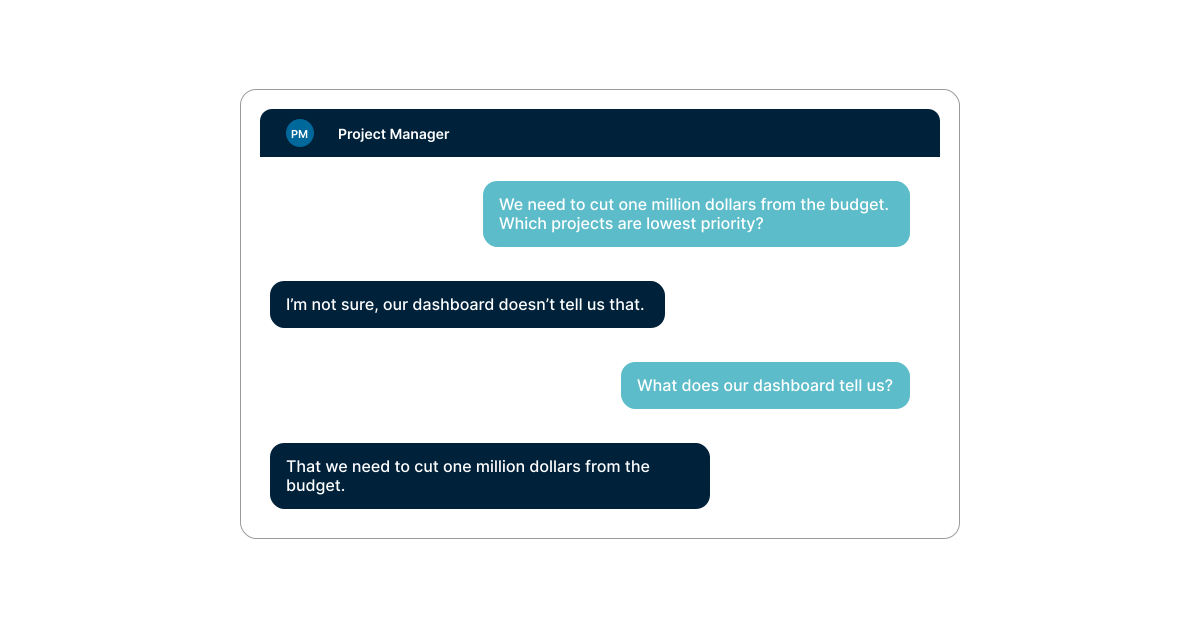
The failure usually shows up under pressure.
A budget cut. A portfolio reset. A sudden constraint.
That exchange isn’t a tooling glitch. It’s a category mismatch.
Dashboards were never built to answer that question.
What dashboards are good at
Dashboards do create real value.
They are excellent at aggregating data, monitoring performance, explaining variance, and supporting review.
They answer:
What happened? What’s happening now? Where should we look?
They are visibility systems. They help organizations understand reality
But understanding reality is not the same thing as choosing a path forward.
Why “more data” never resolves prioritization
When decisions stall, the instinct is predictable: we need better data.
So teams add sources, refine models, and extend dashboards. Confidence improves — but only about the past.
That’s because data reduces uncertainty about facts.
Decisions are constrained by trade-offs.
No amount of data will tell you which initiative deserves to die.
No dashboard will rank mutually incompatible priorities on your behalf.
The moment you ask:
- How will our business look next year?
- What stops so something else can move?
You’ve crossed from analysis into commitment.
Dashboards don’t go there.
Decisions are commitments, not insights
This is the core distinction most organizations never make explicit.
Insights inform.
Decisions commit to action.
A real decision requires:
- An explicit set of choices
- Clear constraints
- A selection rule
- Acceptance of downside
Dashboards can inform indefinitely. They never force closure.
That’s why they feel productive right up until someone must choose.
The decision flow most organizations never finish
This is where the gap becomes obvious.
Most organizations are highly instrumented at the first step — and improvisational everywhere else.
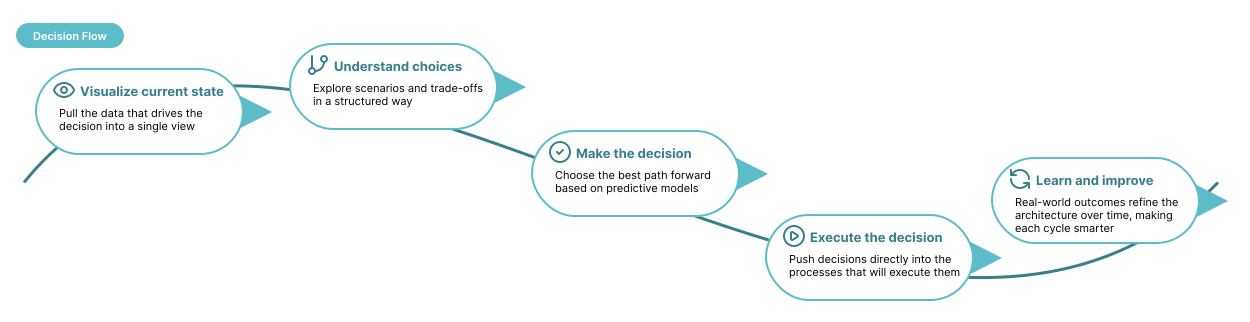
- Visualize current state
Metrics, KPIs, dashboards. Necessary. Table stakes. This is where most analytics investment lives. - Understand choices
Explicit scenarios. Trade-offs surfaced. Constraints applied. This is where decisions start and where most tools stop. - Make the decision
One option is selected. Others are explicitly rejected. Accountability enters. - Execute the decision
Plans, budgets, and systems are updated. Consequences begin. - Learn and improve
Outcomes are compared to intent. Models are refined. The next cycle is smarter.
Dashboards answer “where we are.”
Decisions require choosing “where we will and won’t go.”
Why this gap keeps landing on strategy teams
This failure doesn’t happen because organizations are careless. It happens because of how responsibility is split.
Strategy teams within or across functions are asked to:
- Bring options
- Frame trade-offs
- Support leadership decisions
But the tools they’re given stop at visibility. The decision itself is left to meetings, judgment, and escalation.
The result is a familiar bind: owning outcomes without owning the decision system.
So every cycle feels like starting over.
What changes when decisions become the unit of value
When organizations treat decisions instead of dashboards as the focus of tool design:
- Trade-offs are explicit before escalation
- Constraints are enforced consistently
- Execution is built in, not assumed
- Learning compounds instead of resetting
The good news: your dashboard work wasn’t wasted
The data, pipelines, and dashboards you’ve invested in are not the problem.
They are the foundation.
Step 1 of the decision flow — understanding the current state — is real work.
It takes time, coordination, and discipline. Many organizations never get that far.
The issue is what happens next.
Dashboards stop at description.
Decision systems start where dashboards end — by taking that same data and forcing explicit choices, trade-offs, and constraints.
In other words:
Your dashboards already power the first step of good decisions.
They just were never designed to finish them.
The question that matters next cycle
The next time a real trade-off hits: budget cuts, prioritization, allocation will you come into the room with dashboards that explain the problem or with a decision with alternatives already structured?
That difference is where value actually gets created.