
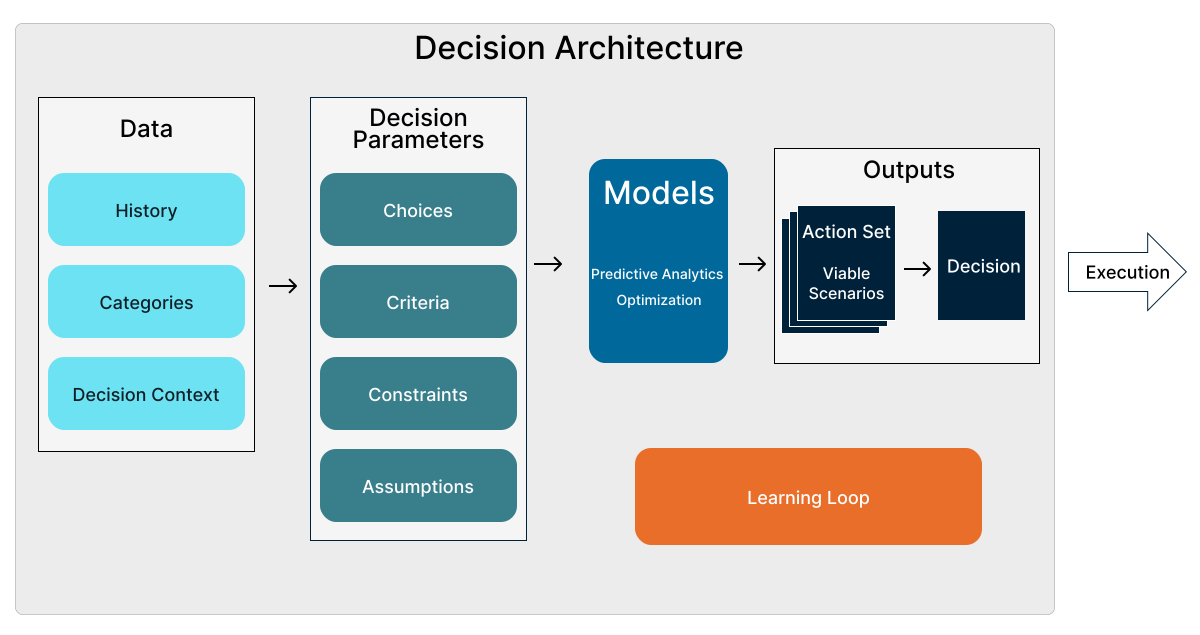
Decision Architecture is the explicit, machine-readable blueprint that defines how a decision is made, covering data, rules, models, and the learning loop .
Its purpose is not to produce the “right” answer once, but to ensure the same decision logic survives disagreement, time pressure, and execution across cycles.
Most executives say they want “data-driven decisions.” Yet, in the real world, deadlines loom, data is patchy, teams clash, and and decisions quietly revert to whatever is easiest to agree on or hardest to challenge.
The problem isn’t that organizations lack data. It’s that they lack Decision Architecture—the structure that turns insight into a decision the organization can actually commit to and execute. Without it, decisions remain, regardless of how sophisticated the analytics appear.
The problem isn’t that organizations lack data. It’s that they lack Decision Architecture, a foundational component of any serious Decision Intelligence (DI) system.
Decision Architecture doesn’t hand you the “right” answer. What it does is far more powerful: it creates a systematic, repeatable way for the right answer to emerge—regardless of who is in the room, how much time you have, or how messy the inputs are.
Decision Intelligence depends on it. Without a defined architecture, even the best analytics, dashboards, or AI models end up feeding an inconsistent process.
The goal isn’t perfection. It’s consistency, transparency, and continuous improvement as the system learns.
Why Repeatability Matters
Real-world decisions are made in messy conditions:
- Imperfect or incomplete data
- Time pressure
- Competing incentives
- Organizational bias
- Legacy processes nobody wants to challenge
Under those conditions, the brain takes shortcuts. That’s human, but it’s not reliable and it certainly isn’t optimal. Organizations do the same, defaulting to familiar or politically safe choices when decision structure is absent.
Decision Architecture doesn’t eliminate complexity; it makes it navigable. It forces clarity around goals, trade-offs, constraints, future expectations, and fair comparison methods. And once that structure exists, you can use tools to run it consistently—so the same decision made next month, next quarter, or next year follows the same logic.
It replaces outcomes by opinion with outcomes by design so decisions don’t depend on who shows up, who speaks last, or how much time is left.
How Decision Architecture Fits into the Decision Flow
On this site, we often describe Decision Intelligence through the lens of Decision Flow—the repeatable path a decision follows from understanding the current state, through evaluation and selection, into execution and learning.
Decision Architecture is not the flow itself. It is the formal logic that sits underneath it. Architecture defines what choices exist, how they are evaluated, what constraints apply, and how trade-offs are resolved—so that every time the flow runs, it produces consistent, defensible outcomes. This is what turns alignment from a prerequisite into an outcome of the decision system itself.
In other words, Decision Flow is how a decision moves.
Decision Architecture is what makes that movement reliable.
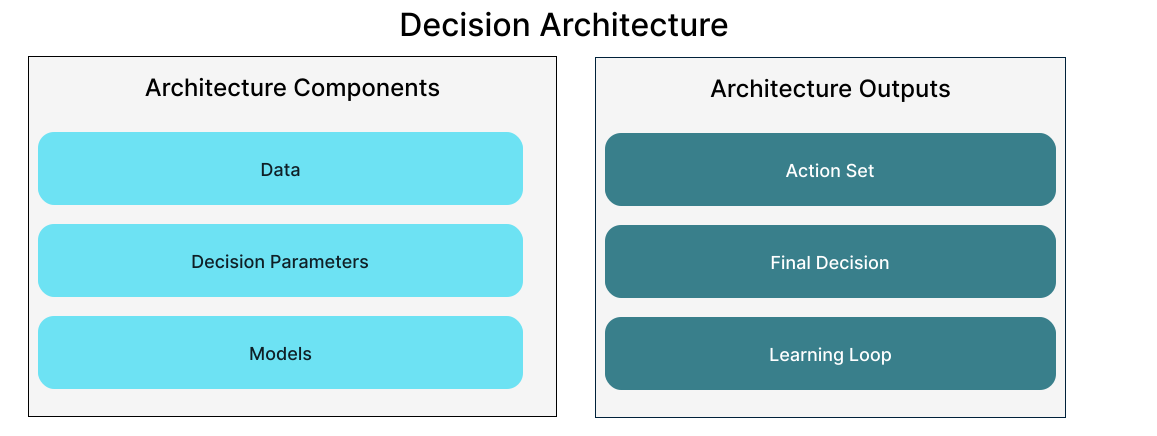
The Elements of a Decision Architecture
- Data
Data enters a decision system in different roles. Each role requires specific preparation, and the role, not the source, determines how the system uses it.
A decision engine interprets data, but the engine doesn't act on the data directly. It acts on Choices, which are constructed inside the Decision Architecture itself.
The data defines the world. The architecture defines what you are allowed to do in that world. Without that boundary, data fuels debate instead of decisions.
We distinguish three roles: Historical Data, Categorical Data, and Decision Context Data.- Historical Data — observed performance
Sales, conversions, lift, utilization, demand, churn, costs, executed placements, forecast accuracy—everything that reflects what actually happened.
Historical data accumulates continually. Executed options add to it.
Elapsed parameters (forecasts, budgets, caps) become part of it for model learning and validation.Historical data must be:- Cleaned
- Reconciled across systems
- Aggregated to the decision grain
- Filtered for relevance
- Analyzed to supply predictive or diagnostic inputs to models
- Categorical Data — the structure of the business
Product hierarchies, regions, customer segments, brand families, channels—the stable entities that define the landscape.
Categories anchor all other data. Historical performance attaches to them. Options and parameters interpreted through categorical data must be:- Enriched with attributes relevant to the decision (e.g., a product classified as “premium,” “value,” or “emerging”
- Normalized across sources
- Linked to decision options, decision parameters, and historical data
- Decision Context Data — the conditions supplied to the decision Forecasts, budgets, inventory ceilings, expected demand, program capacities, or any forward-looking or externally provided inputs that shape the environment in which decisions are made. When the period passes, many context elements (like forecasts) enter the historical layer as observed predictions.
Context Data must be:- Validated for plausibility
- Aligned to the decision grain and time horizon
- Reconciled with historical evidence
- Linked to categorical structures
- Historical Data — observed performance
- Decision Parameters
Decision Parameters define the logic of the decision itself. They are the backbone of Decision Intelligence.- Choices — the viable actions the system can explore
Choices represent the actions the decision-maker or system is allowed to consider.
Choices are not data points., they are decision constructs, defined entirely by the architecture and dependent on the decision type. They feed the optimization models directly.
They may originate from data (e.g., a list of proposed placements), or they may be constructed by the decision logic itself.
Examples:- Strategic Planning: A list of proposed projects submitted for approval
- Fleet renewal: Add vehicles, replace existing ones, refurbish them etc.
- Category management: renegotiate a supplier agreement, add a supplier consolidate volume, etc.
- Criteria — What the organization values
Examples: Cost, ROI, Risk, Growth, Customer Loyalty, Strategic Alignment
Criteria define trade-offs and must be measurable, even when qualitative. - Constraints — the non-negotiables
Examples: Budget ceilings, regulatory limits, staffing caps, operational capacities, inventory thresholds.
Constraints define what is allowed, not what is ideal. Some constraints are external and fixed (e.g. regulatory limits), while others can be defined and explored within a scenario. - Assumptions — expectations about the environment
Examples: Market growth, competitive moves, pricing expectations, demand sensitivity, corporate forecasts.
Some assumptions are fixed (e.g., finance’s revenue target). Others are variable and can change as different scenarios are explored.
Assumptions don’t become constraints just because they are fixed. Constraints define feasibility; assumptions define the world the decision is made in.
- Choices — the viable actions the system can explore
- Models
Models translate Data + Decision Rules into actionable options.
Two modeling approaches matter inside the architecture:- Predictive Analytics
Estimate how different options will perform relative to criteria, using historical evidence and contextual signals. Predictive analytics make the future state quantifiable.
Examples:- Revenue uplift predictions
- Demand forecasts
- Cost estimates
- Churn or retention likelihood
- Optimizers
Given constraints, assumptions, and criteria, optimizers search the space of feasible choices and identify the best combinations. Optimization is where architecture becomes operational rather than conceptual.
Examples:- Portfolio optimization
- Budget allocation
- Vendor selection
- Route design
- Resource balancing
- Predictive Analytics
- Action Set
An Action Set replaces opinions with options. The output of the Models layer is a structured Action Set—the set of viable, analytically justified scenarios that:- Satisfy all constraints
- Incorporate all assumptions
- Optimize the criteria
- Decision
The Action Set doesn’t eliminate human judgment—it amplifies it.
Instead of open-ended debate, decision-makers choose from among analytically justified scenarios. This creates clarity, alignment, and defensibility and is what allows organizations to move forward without reopening the decision during execution. - Learning Loop
This is where a decision architecture becomes a Decision Intelligence system. Without learning, a system stagnates.With learning, it compounds. This learning loop is what separates analytics from intelligence
After executing a decision, the DI application and the organization observe actual performance, model accuracy, asssumption failures, and operational issues (failed constraints).
These outcomes feed back into:- Data→ new historical performance
- Decision Rules→ refined assumptions, constraints, criteria
- Models→ retrained predictors, recalibrated optimizers
Execution
Execution is not part of the architecture itself, but it is what the architecture feeds.
Execution generates:
- transactional results
- operational outcomes
- new historical performance
- signals about assumption accuracy
- real-world feedback about friction, feasibility, and impact
Execution closes the loop—but the architecture stops at producing the decision.
We will discuss Execution more deeply elsewhere.
Examples
Let’s bring it to life with a couple of examples, we will use a personal one (buying a car) and a business one (product portfolio investment) to demonstrate how decision architecture works across a diverse range of decisions.
| Element | Example 1 | Example 2 |
|---|---|---|
| Question | What model car should I buy? | How should I invest across my product portfolio? |
| Data | Reliability scores, vehicle categories, and a defined list of candidate models | Brand revenue history, customer segmentation, and definitional opportunities |
| Decision Parameters - Constraints | Budget, seating capacity, parking space | Budget, engineering capacity, GTM bandwidth |
| Decision Parameters - Assumptions | Fuel prices and expected distance driven | Market trends and competitor launches |
| Decision Parameters - Criteria | Comfort, operating efficiency, cost | Strategic fit, customer impact, revenue potential |
| Models | Cost-of-ownership forecasts and ranking optimization | Predictive demand and optimized budget allocation |
| Action Set | Shortlist of viable models | |
| Decision | Model to buy | Go-forward portfolio |
| Learning Loop | Actual maintenance costs and usage patterns inform the next purchase cycle | Accuracy of models and realized revenue |
The Payoff: Moving from Analytics to Decision Intelligence
Without a proper Decision Architecture, your company's choices often default to disorganization:
- Inconsistent rules being applied
- Unclear assumptions and shifting criteria
- Meetings dominated by opinion or ending in a "decision by exhaustion"
The core issue isn’t data.
It’s the lack of a coherent structure for using it.
Operationalizing Decision Architecture
When you embed this formal architecture—the rules, data, and models—into software, you gain a significant advantage. The software:
- Makes the logic explicit
- Enforces it consistently
- Improves it as performance results accumulate
This is the difference between simply analyzing data and actually running a predictable, intelligent business.
The Bottom Line: Structure Wins
Decision Architecture is the foundational mechanism that makes Decision Intelligence real. It delivers:
- Alignment
- Rigor
- Repeatability
- Speed
- Transparency
- Compounding improvement
And it doesn’t replace human judgment, it amplifies it.
High-performing organizations do not just make decisions.
They design their decision system—and they refine it continuously.
Decision Architecture is what prevents insight from dissolving into debate and strategy from reverting to inertia.