
““A wealth of information creates a poverty of attention.” — Herbert Simon
Organizations today have more data, more dashboards, more analytics, and more AI than at any point in history.
On paper, this should be a golden age of decision-making.
In reality, most leaders experience the opposite.
They know change is required — but struggle to decide what should change, how far to go, and how to make that decision stick.
The problem isn’t a lack of information. Most organizations are drowning in it.
The problem is what happens after the analysis is done.
Decisions stall. Meetings multiply. Priorities blur. Plans quietly revert to what was done last year — not because it worked, but because changing course would require alignment that feels too costly to achieve.
We call this the commitment gap.
The commitment gap is the distance between recognizing that change is required and having the clarity, alignment, and structure needed to decide what should change — and to execute that decision without it unraveling.
When the commitment gap exists, the symptoms are familiar:
- Endless meetings where nothing is actually decided
- Dashboards that explain what happened but avoid telling anyone what to do
- Process improvements that substitute for real choices
- Decisions that remain socially reversible, even after they’re “made”
These behaviors aren’t accidents. They are how organizations cope when commitment is hard and disagreement is expensive.
Research consistently confirms this pattern. McKinsey finds that high-quality debate in big-bet decisions makes companies far more likely to succeed — and that poor decision processes, not lack of data, are what stall strategic management and destroy value. Bain shows that organizations with decision clarity execute faster and more effectively. Gartner reports that most organizations still use data selectively to justify decisions they’ve already made.
The issue is not insight.
It is commitment.
For a decision to be made — and to survive execution — three things must be true:
- A transparent, shared understanding of what decision is being made and what the viable options are
- A clear view of the trade-offs between those options
- A defined path that translates the selected option into execution, without reopening the decision at every step
When any of these are missing, the commitment gap widens — and decision quality degrades, no matter how sophisticated the analytics appear.
Decision Intelligence exists to close that gap.
It is not about adding more data or more models. It is about creating the clarity and structure required to decide what change actually makes sense — and to make that decision durable enough to move an organization forward.
What really is Decision Intelligence (DI)?
People use the term “Decision Intelligence” in many ways. Our definition is straightforward, execution-focused, and practical:
Decision Intelligence is the application of analytics, optimization, and/or AI to build decision systems that make trade-offs explicit, produce a bounded action set, and carry decisions into execution and learning.
Its distinguishing feature isn’t just prediction, it’s commitment: decisions that span the lifecycle from problem to execution.
Decision Intelligence emerged to address a specific failure: organizations were getting better at analysis without getting better at committing to and executing decisions.
As data, models, and forecasts improved, many organizations discovered a harder problem: knowing more did not make it easier to decide what to do — or to follow through once a decision was made.
Decision Intelligence addresses this gap by structuring decisions in a way that makes assumptions explicit, trade-offs unavoidable, and outcomes durable across execution.
A DI system systematically evaluates options, recommends or selects actions, executes them, and improves through feedback. It does this through a Decision Architecture that encompasses five elements:
- Data (Historical, Categorical, Context)
- Decision Parameters (Choices, Criteria, Constraints, Assumptions)
- Models
- Outputs (Action Set, Decision)
- Learning Loop
DI is not just dashboards or generic “AI for decisions.”
Dashboards persist because they are politically safe: they inform without forcing the organization to commit to a specific course of action.
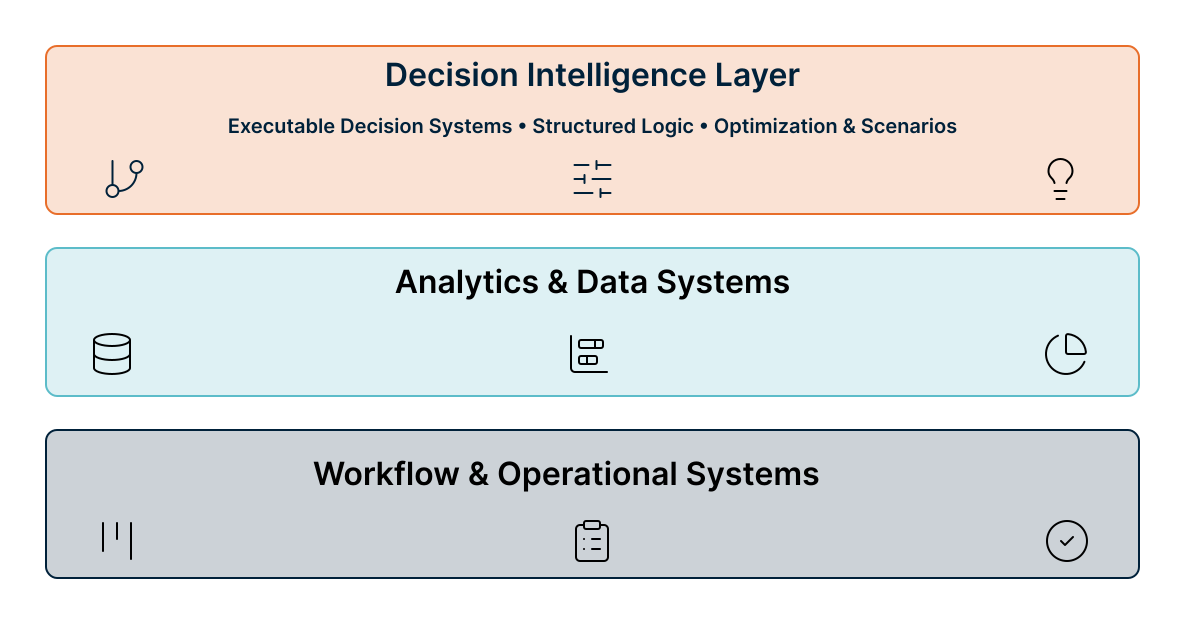
DI is a framework for making critical choices. Most organizations lack systems tailored for decision-making, and DI provides this necessary operational layer.
Where Decision Intelligence Matters Most
Decision Intelligence matters most where organizations routinely fail to converge and follow through—where decisions get renegotiated, drift during execution, or revert next cycle. These are the decisions where the commitment gap is most expensive.
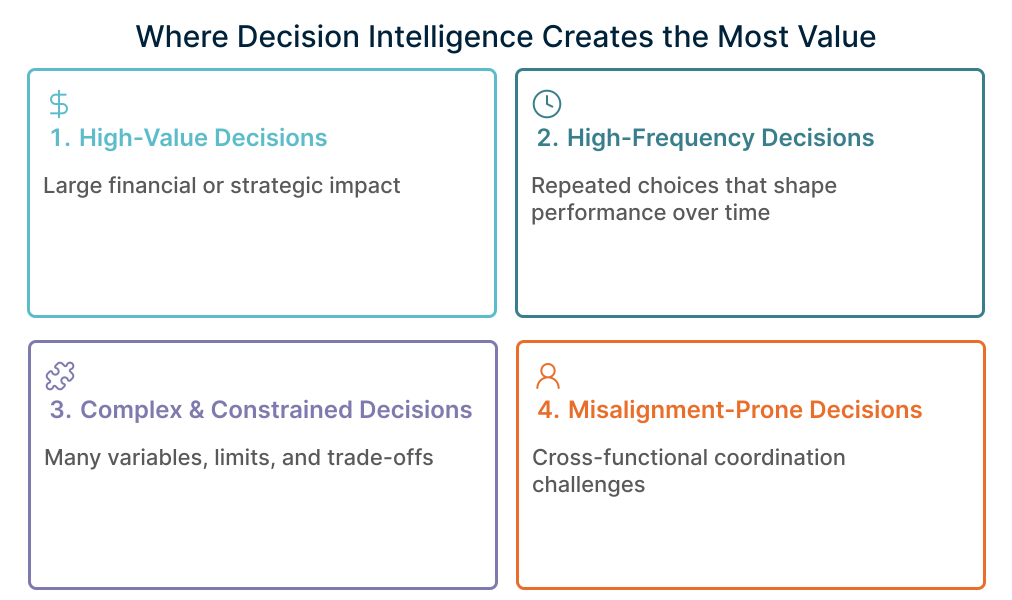
- High-Value Decisions
These decisions significantly influence organizational performance and direction, including product investment, capital allocation, pricing, and portfolio design.
Example: When a company determines its product portfolio for the upcoming fiscal year:
Which products will receive increased investment?
Which will maintain their current level?
Which will be discontinued?
The implications of these choices extend to margin impact, supply chain capacity, and strategic competitiveness. Even minor changes can shift results by tens or hundreds of millions of dollars; these decisions typically recur annually or semiannually and substantially shape the business trajectory.
Importance of DI: This process extends beyond traditional spreadsheet analysis requiring constraint modelling, scenario planning, and trade-off evaluation. - High-Frequency Decisions
Individually minor, these decisions collectively exert a substantial aggregate impact. A single suboptimal allocation may seem negligible, yet repeated thousands of times annually it significantly influences revenue and margins.
Example: A retailer making their weekly inventory allocation across hundreds of stores.
Importance of DI: Without explicit assumptions, constraints, and criteria, bias accumulates and outcomes depend on individual interpretation rather than shared logic. - Complex, Constrained Decisions
While humans can address such decisions, consistency and reliability remain challenging at scale.
Example: A telecommunications provider prioritizing network upgrades within capital constraints—balancing variables such as customer density, revenue potential, regulatory requirements, service risks, competitive pressures, and construction feasibility.
The complexity exceeds heuristic intuition and is too vast for conventional spreadsheets.
Importance of DI: Decision Intelligence (DI) integrates the underlying logic and clarifies trade-offs. - Decisions Where Misalignment Reduces Value
These decisions are less complex technically but pose significant organizational challenges.
Example: Annual planning involving Product, Sales, Finance, and Operations.
Each function may optimize based on unique incentives, introducing varied assumptions and differing definitions of “success,” which can transform meetings into negotiations rather than effective decision-making sessions.
Importance of DI: DI closes the commitment gap by forcing shared assumptions and explicit trade-offs early, so the decision is settled before execution becomes a negotiation. Alignment becomes an output of the decision system, not a prerequisite that stalls it.
The Three Modalities of Decision Intelligence
Because decisions differ, DI is not one thing. It comes in three primary modalities. These modalities describe how DI expresses itself, depending on the pace, complexity, and collaboration needs of the decision. These are different than decision types, which we discuss elsewhere. Each modality is a different way of closing the commitment gap—through automation, structured judgment, or enforced shared logic.
- Automated DI
When DI replaces human judgment because the decision is fast, mathematical, and structured. It may occur continuously or only in exceptional circumstances, but the DI application automates the decision completely. Automated DI removes the commitment gap by removing discretion: the organization isn’t asked to align each time—execution is the alignment.
Examples: Airline disruption recovery, real-time bidding, dynamic routing.
Role: Optimization engines compute and execute decisions automatically. - Augmented DI
When DI improves human judgment by structuring trade-offs, comparing scenarios, and exposing consequences. These systems are data-driven, use predictive analytics and/or optimization, but the outputs are given to the organization to make a final decision.
Examples: product portfolio decisions, budget allocation, pricing and promotions.
Role: Tturn judgment into a clearly defined choice by making assumptions and trade-offs explicit—so the decision can be made once and executed without relitigation. - Structured Collaboration DI
When DI reduces political friction by aligning stakeholders on shared assumptions, constraints, and decision logic. In Structured Collaboration DI, the system becomes the sole source of truth for how the decision works combining assumptions, constraints, criteria, and scenarios and eliminating conversational drift.
The goal is decision durability: once the organization commits to the model, the decision can’t be quietly renegotiated by whoever talks last. These are usually assumption driven, the DI application is focused on transparency and comparability rather than predictive modelling.
Examples: annual planning, cross-functional prioritization, program rationalization.
Role: accelerate alignment by aligning the model of the decision.
Obviously before determining the appropriate DI approach it is important to know what modality you are targeting.
The Decision Ecosystem
Every organization already has a Decision Ecosystem. The Decision Ecosystem is the combined people, processes, governance, and tools through which decisions actually get made—and undone.
Some are intentional and structured; others are informal, personality-driven, or stitched together through meetings, spreadsheets, and instinct. But an ecosystem exists whether you’ve designed it or not.
- Decision Governance — who decides, how alignment is created, and how authority works
- Decision Flow — the repeatable process through which a decision progresses
- Decision Architecture — the formal, machine-readable logic that makes the decision modellable
When these three elements are explicit and integrated, organizations move from “decision by inertia” to decision by design.
Decision Intelligence provides the tooling layer inside this ecosystem, but the ecosystem itself is broader, it is the operating environment in which DI drives real outcomes.
Decision Governance
Before you can optimize a decision, you must define who owns it and how it is governed. Governance is the human layer of the ecosystem, the structure that makes decisions legitimate, enforceable, and aligned. There is extensive research and documentation on decision governance so we will only describe it briefly here.
Decision Governance defines:
- Roles and responsibilities
Who proposes, who evaluates, who approves. - Decision rights
Clear ownership, escalation paths, and boundaries. - Cadence and timing
When the decision happens and on what cycle. - Alignment mechanisms
How cross-functional teams reconcile incentives and perspectives. - Evaluation criteria for success
How the quality of the decision is measured over time.
Without governance, the organization can treat the decision as optional—and the commitment gap reopens immediately.
With governance, DI becomes the amplifier — a system that enforces clarity, discipline, and repeatability across cycles.
Governance is not about bureaucracy. It is about the minimum structure required to prevent drift, deadlock, and politics from replacing analysis and strategy.
Decision Flow
Every high-value decision should follow a predictable path. The diagram below represents the Decision Flow—the process dimension of the Decision Ecosystem. It shows how a decision moves from understanding the current state, through scenario exploration and model-supported evaluation, into execution and ultimately learning.
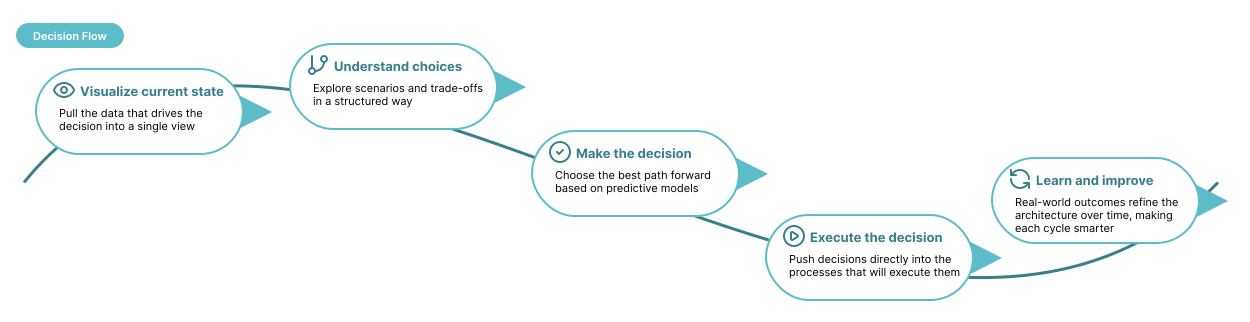
Decision Flow is not about describing what the models do. It is about ensuring the humans involved in the decision move through a consistent, aligned sequence every cycle. It creates a shared rhythm. More importantly, it prevents decisions from becoming eversible by forcing the same sequence and decision point each cycle:
- Everyone begins with the same factual grounding
- Choices are explored systematically rather than improvised
- The actual decision point is explicit, not buried in meetings
- Execution is connected directly to the decision logic
- Outcomes return to the architecture, reinforcing continuous improvement
This flow links the governance of a decision (who decides) to the architecture (how the decision works). It becomes the operational heartbeat of Decision Intelligence—turning a defined decision structure into a repeatable practice.
Where Architecture makes a decision modellable, the Flow makes it workable.
Together, they ensure that decisions no longer depend on memory, personalities, or last-minute persuasion, but on a clear, transparent, and improvable system.
Decision Architecture
Before a decision can be automated, modeled, or optimized, its structure must be made explicit. Decision Intelligence systems cannot guess what a “good” decision looks like; they can only execute the logic you define. That logic is the Decision Architecture.
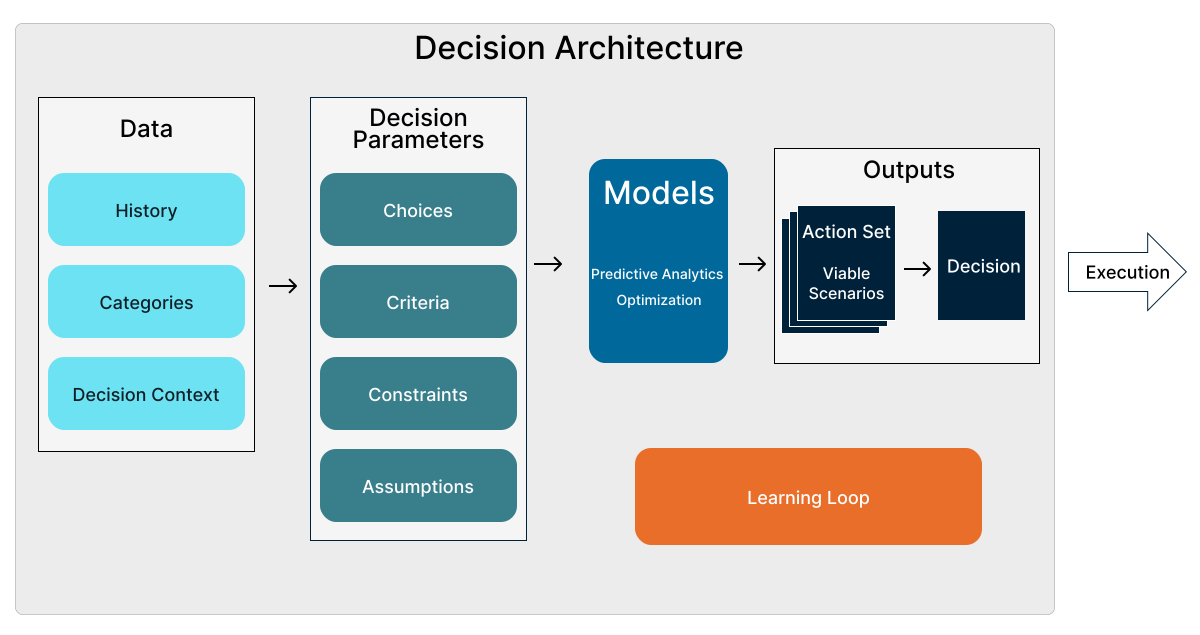
Decision Architecture is the operating system of Decision Intelligence. It is the formal, machine-readable description of how a decision operates. It expresses the decision in a way that humans can understand and algorithms can apply consistently.
A complete architecture has three core components (data, parameters, models) and produces three operational outputs (action set, decision, learning loop).
Architecture Components
Data — what the system knows
DI draws on the three decision-relevant data types:
- Historical Data — what happened
- Categorical Data — structure of the business
- Decision Context Data — the environmental conditions provided to the decision
These must be structured, validated, enriched, and aligned to the decision grain before any modeling begins.
Decision Parameters — how the decision should behave
Decision Parameters define the governing logic:
- Choices — the viable actions the system can explore
- Constraints — what is allowed.
- Assumptions — what is expected.
- Criteria — what matters most.
This is where strategy becomes executable.
Without clear rules, DI systems have nothing reliable to optimize.
Models — how options are evaluated
Two types of models bring the architecture to life:
- Predictive Analytics — estimate future outcomes for each option.
- Optimizers — search feasible combinations and identify the best configurations.
Models don’t dictate the decision.
They make the decision discoverable.
From these components, the system produces:
Architecture Outputs
Action Set — the viable, justified options
A structured set of scenarios that satisfy all constraints, apply all assumptions, and optimize the stated criteria.
Decision — human judgment, now informed rather than improvised
Leaders select from validated options rather than debating from scratch.
Learning Loop — the essential feedback loop
Real-world outcomes refine the architecture over time, making the next cycle smarter.
Architecture Connects Strategy to Execution
Many decision failures happen after the analysis—when assumptions remain implicit and trade-offs remain negotiable, allowing the organization to reopen the decision during execution.
DI won’t save you from that; it will simply formalize your ambiguity unless the architecture forces clarity.
When the architecture is explicit, DI becomes a force multiplier.
Example: Product Portfolio — With vs. Without Architecture
Without Architecture
Meetings collapse into advocacy:
- The product team prioritizes innovation.
- The sales department seeks commitments.
- The finance division values efficiency.
- The operations team focuses on feasibility.
All legitimate perspectives, but no shared model.
With Architecture
The DI system understands:
- The objectives and how important each one is
- Constraints related to budget, capacity, and go-to-market strategies
- Major assumptions about the market
- Definitions for investment strategies: invest, grow, maintain, or sunset
DI uses the architecture to analyze scenarios and expose trade-offs revealing outcomes.
Human expertise is still crucial, but clarity, collaboration and transparency increases dramatically.
Execution is not part of the architecture itself; it is what the architecture feeds. The architecture produces the decision, and execution produces outcomes that return to the Learning Loop.
Architecture becomes the executable logic that drives the DI system, not just a workshop artifact.
Getting Started with Decision Intelligence
Implementing DI should start small and pragmatic.
- Pick a specific decision, not a process.
Choose one that recurs, consumes meetings, matters financially, and suffers from drift or inconsistency. - Make the architecture explicit.
Define criteria, constraints, assumptions, scenarios, actions.
If the team cannot agree on the architecture, it is not ready to agree on the answer. This step alone often resolves the ambiguity that previously stalled decisions. - Test it manually.
You do not need a platform yet.
Walk through a cycle, compare options, challenge assumptions, expose trade-offs.
If clarity improves, you have proven the decision can be systematized.
If the same debate resurfaces next cycle, you didn’t have a decision, you had a temporary ceasefire. - Identify the DI modality.
Most strategic and operational decisions fall into Augmented DI or Structured Collaboration DI. - Define the action-set format.
Determine what scenarios should be run and what constraints, assumptions, and criteria weights should be used in each scenario. - Operationalize the decision.
This is where DI becomes real:- Embed the architecture.
- Connect relevant data.
- Run consistent scenarios.
- Execute with the same logic each cycle.
- Learn from outcomes.
At this point, the decision stops depending on who is in the room.
It becomes a system.
Scale DI one decision at a time.
Effective DI does not scale by adding tools.
It scales by repeating the architecture → modality → operationalization loop across high-impact decisions.
Ensure that culture shifts along the way: that the organization adopts new ways of working and decisions become transparent, predictable, and grounded in shared structure.
Conclusion
DI has existed conceptually for decades, but only now have the ingredients converged — richer data, scalable analytics, flexible optimization, and AI capable of modeling uncertainty. What was once conceptual is now operational. Decision Intelligence operationalizes decision architecture, ensuring that every cycle becomes smarter than the last.
Making better decisions leads to greater success than simply improving dashboards or workflows. Effective decision-making impacts areas such as funding allocation, project development, resource cuts, team alignment, organizational learning, and the transformation of strategy into action. It is not possessing more knowledge that makes companies thrive, it is their ability to make superior choices. Decision Intelligence enables organizations to put this advantage into practice, systematically enhancing each decision, architecture, and cycle.
Organizations don’t fall behind because they lack insight—they fall behind because they can’t convert insight into decisions that stick.
Decision Intelligence closes the commitment gap by making trade-offs explicit, producing a bounded action set, and carrying decisions into execution and learning without reopening them at every step.
In a world where change is constant, the durable ability to decide and follow through is the advantage.