
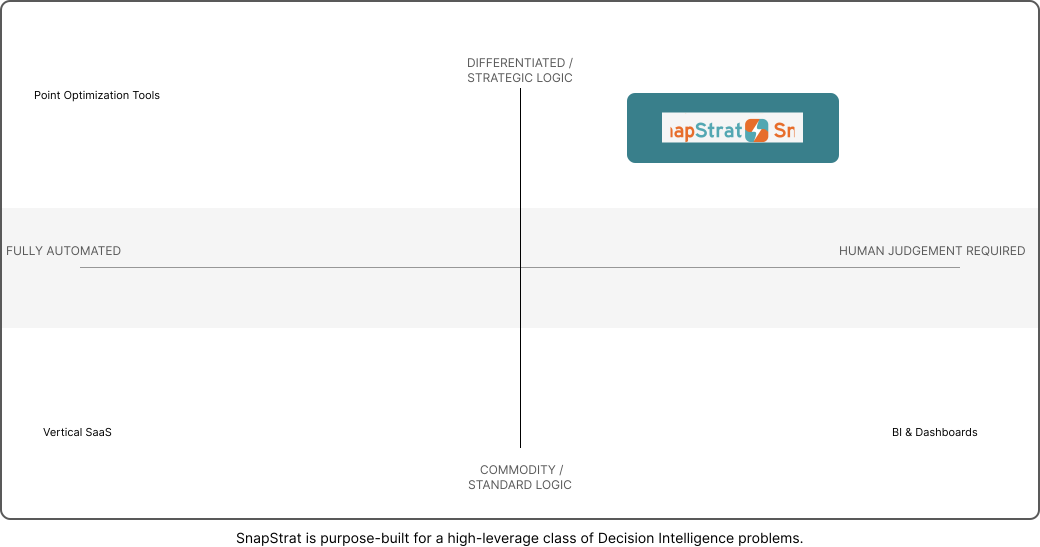
Decision Intelligence is everywhere, and a wide variety of vendors claim to do it. Workflow tools, AI copilots, optimization engines, and full automation platforms all promise to “fix decisions.” But they are built for very different problems, and it is critical that you ensure that the solution you select is appropriate to both your decision and the environment in which it operates.
SnapStrat is built for the decisions that matter most: recurring, high-stakes, cross-functional choices where human judgment is still required, but intuition alone isn’t enough. If your advantage lives in how you analyze and govern those decisions—not just how fast they move through a process, SnapStrat is designed for exactly that reality.
Rather than automating decisions or enforcing process, SnapStrat augments decision-makers with deep analytics, scenario modeling, and optimization so trade-offs are explicit and defensible. The system does the math; people remain accountable for the choice.
If your advantage depends on how a decision is analyzed and governed over time — not simply how fast it moves through a workflow — SnapStrat is designed for that reality. If you’re looking to automate or standardize judgment away, it isn’t.
To understand where SnapStrat fits, it helps to first understand the broader Decision Intelligence landscape — and where we deliberately choose not to compete.
The Decision Ecosystem (The Context We Operate In)
Every organization already has a Decision Ecosystem: people with judgment, governance structures, recurring processes, and operational systems where decisions are executed. Decision Intelligence lives in the tooling layer of that ecosystem—providing the architecture, models, and applications that make complex decisions transparent, structured, and repeatable.
SnapStrat doesn’t replace your people, governance, or process.
We strengthen them.
What SnapStrat Actually Does
SnapStrat builds cloud-based decision systems, applications powered by a formal decision architecture, predictive and optimization models, and integrations that push chosen actions directly into execution systems.
These systems:
- Encode your criteria, constraints, and assumptions
- Generate scenario sets that reflect your actual options
- Reveal trade-offs and risk profiles
- Optimize within real-world limits
- Maintain institutional memory of how decisions get made
SnapStrat is not a custom dev shop. We do not build an application and hand it over for your IT team to maintain.
You get a fully managed system in the cloud, continuously supported, monitored, and evolved as your decision architecture matures.
We are the partner responsible for the tooling layer inside your decision ecosystem.
Your organization brings the people, process, and governance.
SnapStrat brings the operational intelligence.
With that grounding, the next question becomes simple:
When is this the right modality of Decision Intelligence for your organization?
What type of decision are you making?
We talk a lot about “your most important decisions” let’s put more specificity about which decisions we are talking about.
| Appropriate for SnapStrat | Not Appropriate for SnapStrat |
|---|---|
| Strategic decisions that materially affect performance or direction | Tactical or low-stakes operational choices |
| Recurring decisions (monthly, quarterly, annual cycles) | Decisions that fire thousands of times per day, or once in a lifetime |
| High-value decisions where mistakes compound over time | Decisions where errors are cheap or easily reversible |
| Complex trade-offs with multiple objectives and constraints | Single-objective or trivially constrained problems |
| Data-driven but judgment-dependent (augmented, not automated) | Fully automatable decisions with no human judgment |
| Beyond spreadsheet limits due to scale, exceptions, or scenario depth | Problems well handled by BI dashboards or spreadsheets |
| Decisions where logic must be explicit, testable, and governed | Decisions solved by standard off-the-shelf optimizers |
| Decisions where an application that ties outcomes to execution is important | Standalone decisions requiring limited integration |
Bottom line:
SnapStrat is not a general-purpose automation engine. It is the system of record for how your most important decisions are analyzed, governed, and made.
Does getting this decision right actually differentiate you?
Not every decision deserves architecture-driven DI.
Some decisions are commodity—industry-standard processes where off-the-shelf software works fine. Use SnapStrat when the decision is part of how you win.
| SnapStrat Is the Right Fit | Use Off-the-Shelf Instead |
|---|---|
| Your decision logic is unique to your business | Your logic mirrors industry norms |
| Constraints differ meaningfully from competitors | Constraints are standard and well understood |
| Objectives are weighted in non-obvious ways | Objectives are generic (cost, speed, volume) |
| Trade-offs are strategic and contested | Trade-offs are obvious or mechanical |
| Inconsistency creates real economic risk | Inconsistency has limited downside |
| The decision improves through iteration and learning | Best practices are stable and static |
| Decision logic itself is a competitive asset | The decision is a commodity process |
In other words:
If your unique way of making the decision matters, SnapStrat is the right DI modality.
What kind of implementation model do you want?
Even when the decision type and differentiation criteria fit, organizations vary in how they want to implement DI. The answer to the question lies in a trade-off between control, available skills, and adaptability. If you build a fully custom solution you own, you maintain, not only the business logic but the underlying technology, for organizations that are ‘build focused’ on technology this makes sense.
SnapStrat is grounded in the belief that agility and adoption of new technologies is critical to this category of decision, so we chose to build a model where we fully manage the application, much like a SaaS provider does, except this application is custom-built on the SnapStrat Decision intelligence platform.
SnapStrat has a distinct implementation profile:
| SnapStrat Is a Match | SnapStrat Is Not a Match |
|---|---|
| Turnkey and custom (architecture-driven, not templated) | Drag-and-drop or template-first tools |
| Fully managed cloud system | Software your IT team owns and maintains |
| High-touch partnership with decision experts | Pure consulting with no durable system |
| Reusable decision platform that evolves over time | One-off models, POCs, or throwaway analyses |
| Integration into execution systems (ERP, CRM, marketing, supply chain) | Standalone analysis tools |
| Explainable, auditable decision logic | Black-box AI or opaque automation |
| Augmented decision-making with human accountability | Fully automated decision replacement |
SnapStrat sits in the “goldilocks zone”:
Custom decision systems built on a stable DI platform — fully managed and continuously improved.
Putting It All Together: The SnapStrat Sweet Spot
SnapStrat is the right Decision Intelligence partner when all three conditions are true:
- The decision is strategic, recurring, high-value, and complex that a human will make.
- Your way of deciding is part of your competitive identity.
- You want a turnkey + custom, fully managed cloud system that connects decision logic to execution.
When those three filters align, SnapStrat becomes the highest-leverage decision investment you can make.
Examples
Decisions that consistently meet all three filters:
- Allocating marketing dollars across programs, brands, and channels
- Picking and balancing product investments
- Prioritizing R&D or engineering work
- Optimizing procurement and vendor selection
- Allocating constrained inventory or capacity
- Designing distribution or service footprints under uncertainty
These decisions drive margin, growth, and operational efficiency.
They’re too important for guesswork.
They’re too complex for dashboards.
They’re too specific for off-the-shelf software.
Conclusion
Decision Intelligence is broad; SnapStrat is focused.
We’re not the solution for every decision.
But for the decisions that shape performance, resource allocation, and long-term value creation, our architecture-driven DI applications are the right modality.