
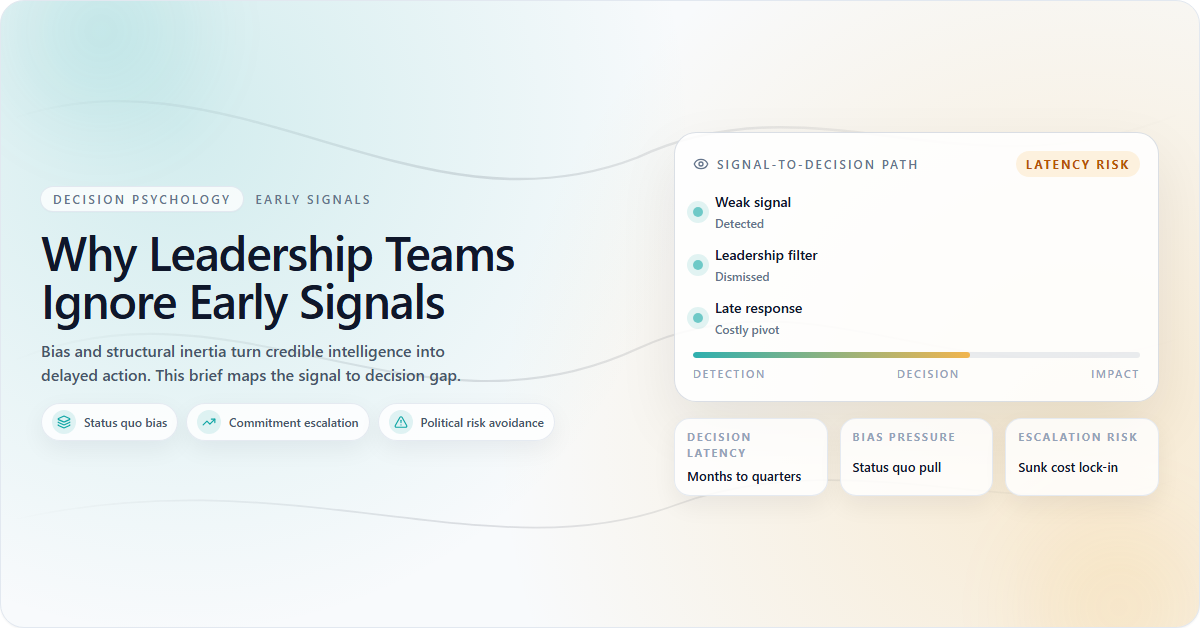
The most expensive mistakes in executive decision-making are rarely made in moments of visible crisis. They are made months, and often years, earlier. They occur when the first credible signals appear, and leadership teams systematically dismiss them. The intelligence is accurate. The data exists. The warnings are present. Yet organizations continue along paths that later prove catastrophic.
This is not an intelligence failure. It is a decision psychology failure.
Across industries, the pattern repeats with unsettling consistency. Manufacturing supply chains are blindsided by geopolitical shifts. Financial services firms are caught unprepared by regulatory change. Organizations invest millions in business intelligence platforms, competitive analysis tools, and quarterly intelligence briefings. They hire strategists, analysts, and advisors whose explicit role is to detect early signals. The intelligence reaches the leadership room. Then it stops.
The Illusion of Intelligence Sufficiency
Most leadership teams operate under a dangerous assumption. They believe that access to high-quality intelligence automatically produces better decisions. This belief is reinforced by the consulting industry, which often sells the promise that better data will solve strategic problems. Empirical evidence tells a different story.
Research on cognitive bias in executive decision-making shows that leadership teams presented with identical information reach very different conclusions. The outcomes depend less on intelligence and more on psychological orientation toward risk, uncertainty, and change. A 2024 study examining strategic decisions across multiple industries found that cognitive biases, particularly status quo bias, escalation of commitment, and loss aversion, had a greater impact on outcomes than the quality of the intelligence available.
The gap between intelligence and action is not informational. It is psychological and structural.
Status Quo Bias and the Gravity of “Good Enough”
Status quo bias describes the cognitive tendency to prefer existing conditions over change. Neurological research shows that maintaining the current state requires less cognitive effort than evaluating alternatives. This creates a biological preference for inertia, even when change is logically justified.
In executive settings, this bias produces predictable behavior. When early signals indicate that a strategic shift may be necessary, leadership teams instinctively weigh the proposal against the psychological and organizational cost of change. They do not evaluate the signal solely on its strategic merits. Existing strategy becomes the reference point. Alternatives are judged relative to it. This creates an asymmetric evaluation process that consistently disadvantages new information.
Evidence from the 2008 financial crisis illustrates the effect. A study of central bank responses found that status quo bias delayed intervention despite clear early warning signals. The European Central Bank adhered to traditional frameworks longer than necessary, contributing to a slower recovery. The Federal Reserve possessed similar intelligence about systemic risk and initially hesitated, adopting unconventional measures only later.
The Executive Intelligence Framework addresses this by changing the decision architecture. Intelligence is not framed as a challenge to existing strategy, which triggers defensive reactions. Instead, intelligence is positioned within a continuous strategic adjustment model. The framing shifts. The question is no longer whether the organization should change strategy. The question becomes: how does intelligence inform the next strategic iteration? This reframing reduces the psychological resistance created by status quo bias.
Organizations using SnapStrat’s decision intelligence platform report a 40% reduction in decision latency for strategic pivots when intelligence is embedded in iterative decision cycles rather than introduced as discrete change proposals. The intelligence did not improve. The decision psychology did.
The Structural Reinforcement of Inertia
Status quo bias rarely acts alone. Organizational structures amplify it. Governance processes, capital allocation systems, and accountability frameworks are typically designed for stability rather than adaptability.
When early signals suggest a market shift, psychological inertia combines with structural friction. Executives face the discomfort of abandoning existing strategy and the practical difficulty of reallocating capital, reorganizing teams, and explaining change to boards and investors. Research on organizational inertia identifies three forms. Insight inertia reflects failure to detect signals. Action inertia reflects failure to respond despite detection. Structural inertia reflects institutional resistance to change.
Action inertia is the most dangerous. It represents the gap between knowing change is required and actually making it. An analysis of Fortune 500 strategic failures found that in 68% of cases, leadership teams had intelligence about the threat. They delayed action due to resource and routine rigidity. Status quo bias magnified both.
Psychological safety plays a critical role. In environments where challenging the status quo is socially risky, early signals are not merely dismissed. They are often never raised. Research shows that psychological safety predicts whether intelligence reaches decision makers more strongly than intelligence quality itself. When executives fear reputational damage from advocating uncomfortable change, bias distorts information flow before decisions are even made.
Commitment Escalation and the Trap of Past Investment
Status quo bias explains resistance to change. Commitment escalation explains something worse. Leadership teams often double down on failing strategies even as evidence mounts against them. This behavior, often described as the sunk cost fallacy, reflects the tendency to continue investing based on prior investment rather than on future value.
Economic theory predicts that rational actors ignore sunk costs. Human behavior does not follow that rule. Loss aversion means losses feel more painful than equivalent gains feel rewarding. This creates pressure to continue using failing strategies to avoid recognizing a loss.
Barry Staw’s 1976 research on escalation of commitment showed that decision makers who initiated a failing project were far more likely to escalate investment than outsiders evaluating the same project. Executive teams amplify this effect. The reputational cost of admitting strategic error is high.
Later research adds a social dimension. A 2021 study found that escalation of commitment is often perceived as a sign of trustworthiness. Observers viewed leaders who stayed the course as more reliable than those who pivoted. Decision makers who escalated commitment were entrusted with 29% more resources. Organizational culture rewarded the very behavior that leads to failure.
This creates a vicious cycle. Early signals indicate failure. Leaders face a choice. They can acknowledge error and change course, or they can escalate in hope of eventual vindication. Loss aversion and reputational incentives push decisions toward escalation.
Senior executives are particularly vulnerable. Research on executive overconfidence shows that CFOs overestimated their ability to predict market outcomes by roughly 40% when evaluating their own decisions. Loss aversion, reputational pressure, and overconfidence combine to reinterpret warning signals as temporary setbacks rather than indicators of structural failure.
The Organizational Amplification of Escalation
Commitment escalation becomes more dangerous inside organizations because it operates at multiple levels. Individual executives escalate personal commitments. Leadership teams escalate collective decisions. Organizations, through path dependence and resource lock-in, escalate strategic direction.
A 2023 study found that sensation seeking, hubris, and managerial rank were associated with increased escalation behavior. Top management teams escalated failing strategies more often than lower-level managers. Hubris amplified the effect. The most confident executives were the most exposed.
The traits that help leaders rise, confidence, decisiveness, and commitment, become liabilities when intelligence contradicts strategy. The larger the investment, the greater the pressure to escalate. The more senior the leader, the higher the psychological cost of admitting error.
The Executive Intelligence Framework counters this by institutionalizing decision retrospectives and signal validation protocols. Strategic decisions are treated as hypotheses subject to ongoing testing. The focus shifts from defending who made the decision to evaluating what the intelligence indicates about market reality.
This depersonalization matters. Research shows accountability increases escalation when framed around defending past decisions. Accountability reduces escalation when framed around objective evaluation of outcomes.
SnapStrat operationalizes this through decision traceability and outcome tracking. The platform records what intelligence existed, what decisions were made, and what results followed. Accountability moves from justification to learning. Organizations using this approach report a 35% reduction in escalation behavior for initiatives flagged by early warning systems.
Political Risk Avoidance and the Cost of Raising the Alarm
The third psychological barrier is political risk avoidance. Even when executives understand early signals, organizational politics discourage speaking up.
Research on corporate political risk shows executives often underweight politically sensitive intelligence, not because they doubt accuracy, but because surfacing it creates friction.
A Harvard Law School study found nearly half of firms avoided foreign direct investment due to political risk. Executive risk aversion explained most of the effect. The internal political risk of challenging consensus often outweighed external risk considerations.
Younger executives exhibited stronger avoidance behavior than senior leaders. Career concerns suppressed early warnings, especially in firms with severe agency problems where personal advancement outweighed shareholder interest.
This dynamic shapes intelligence flow. Mid-level strategists and analysts often detect early signals first. They also face the greatest career risk in surfacing them. Challenging strategic direction disrupts momentum and positions the messenger as an obstacle. In low-psychological-safety environments, intelligence is filtered before it reaches leadership.
A 2022 study showed that psychological safety moderated perceptions of speaking up. In low safety environments, voicing concerns harmed perceived contribution. In high safety environments, it increased.
The implication is clear. Intelligence quality alone does not determine what reaches leadership. The political economy of information determines it. When raising alarms is risky, intelligence systems reinforce existing strategy rather than challenge it.
Organizational Design Failure
This problem intensifies when intelligence gathering is distributed while decision authority is centralized. Analysts scan markets across the organization. Decision-making funnels upward through hierarchical layers. Each layer filters information.
Research shows hierarchical filtration systematically removes uncomfortable intelligence. Middle managers adapt rationally. They emphasize confirming signals and downplay contradictions because organizational incentives reward alignment.
One study found organizational culture influenced first-level management decisions more than any other factor, including intelligence quality. Culture and politics dominate information impact.
The Executive Intelligence Framework addresses this by redesigning decision cadence and information flow. Intelligence becomes part of a continuous strategic review rather than an episodic challenge. The Quarterly Intelligence Briefing creates a predictable rhythm. Early signals become expected.
This changes incentives. Surfacing early intelligence becomes routine performance rather than dissent. Analysts are evaluated on signal quality and timing, not political convenience.
SnapStrat reinforces this through transparent traceability. Decisions link directly to intelligence and outcomes. Suppression becomes visible. Accuracy becomes rewarded. Over time, incentives shift from conformity to truth.
How Biases Compound
Status quo bias, commitment escalation, and political risk avoidance reinforce one another.
A typical failure unfolds predictably.
Early signals appear. Status quo bias discourages serious evaluation. Political risk suppresses the escalation of concerns. Leadership receives diluted intelligence. Investments proceed. Sunk costs accumulate. Stronger signals emerge. Commitment escalation drives doubling down. Political risk intensifies. Correction becomes harder. Crisis forces change.
This pattern is documented across failures at Kodak, Nokia, and financial institutions before 2008. The intelligence existed. Leadership saw it. Decision psychology determined the outcome.
Decision Intelligence as Intervention
Traditional strategy improvement focuses on better intelligence. The Executive Intelligence Framework takes a different path. It intervenes in decision psychology.
The framework rests on three principles.
Early signal detection is institutionalized and rewarded through a predictable cadence. Strategic commitments are depersonalized and treated as testable hypotheses. Decision traceability links intelligence, decisions, and outcomes.
Organizations using decision intelligence platforms respond faster, adapt more frequently, and escalate less often. The difference lies not in what they know but in how they decide.
Research on decision velocity shows that organizations that maintain quality while accelerating decision-making outperform peers in volatile markets. Velocity improves by reducing psychological friction, not by forcing speed.
Designing for Decision Psychology
Leadership teams are often built to create consensus and stability. These traits help until volatility demands adaptation.
Effective leadership under uncertainty requires holding strategy lightly while maintaining coherence through change. This is the capability the Executive Intelligence Framework builds.
It enables organizations to detect weak signals, surface uncomfortable intelligence, evaluate objectively, act quickly, and learn systematically.
Behavioral strategy research shows that organizations that design for bias mitigation outperform those that rely solely on intuition. McKinsey found measurable improvements in decision quality where behavioral interventions were applied.
The implication is direct. Decision architecture deserves the same investment as operations, finance, and talent.
Diagnostic Questions
Leadership teams should ask themselves:
When did strategy last change based on early signals rather than a crisis? How long does it take from signal detection to decision? Is the existing strategy treated as the default truth or one option among many?
How are underperforming initiatives evaluated? Is exit possible without penalty? How many initiatives have materially changed over three years?
Do uncomfortable signals reach leadership? What intelligence likely exists but never surfaces? How safe is it to challenge consensus?
These questions are uncomfortable by design. Organizations that answer honestly and act gain structural adaptability.
Closing Reflection
Every leadership team has a dominant decision failure mode. Some suffer inertia. Some escalate commitment. Many suppress intelligence due to politics.
Identifying the dominant bias is the first step. The Executive Intelligence Framework and SnapStrat Decision Intelligence provide the architecture to intervene, not by generating more intelligence, but by changing how decisions are made.
Competitive advantage now depends on adaptive velocity. The intelligence has always been present. The question is whether leadership is designed to act on it.
Which bias shows up most often in your leadership room?
About the Executive Intelligence Framework
The Executive Intelligence Framework integrates strategic intelligence, geopolitics, and behavioral decision science to help leadership teams bridge the gap between signals and action. Built through decades of consulting with Fortune 500 and mid-market organizations, it provides the decision architecture required for volatile markets.
About SnapStrat Decision Intelligence
SnapStrat operationalizes behavioral strategy by linking intelligence, decisions, and outcomes. The platform reduces cognitive bias, increases transparency, and accelerates adaptation by making decision traceability visible.
For more on applying the Executive Intelligence Framework or exploring SnapStrat Decision Intelligence, connect with me on LinkedIn or visit Inngility Advisors.