
Every organization does strategic planning to determine how scarce capital, expense, and resources should be allocated to discretionary initiatives. It is the single most important decision linking business strategy to execution.
Yet, most organizations still run strategic planning the same way they did in the 1980s, and the result is the same: strategic plans that don’t live up to the promise of the strategy.
Most strategic plans don’t fail because teams lack insight, data, or intelligence.
They fail because insight alone does not produce commitment.
The real breakdown happens between knowing change is required, deciding what will change, and then carrying that decision through execution without it unraveling.
If your strategic plan lives in slides or spreadsheets, the failure modes are predictable. They show up again and again, even in well-run organizations, for the same underlying reason. Let’s look at four common failure modes that hinder both making data-driven strategic planning decisions and driving them through to execution.
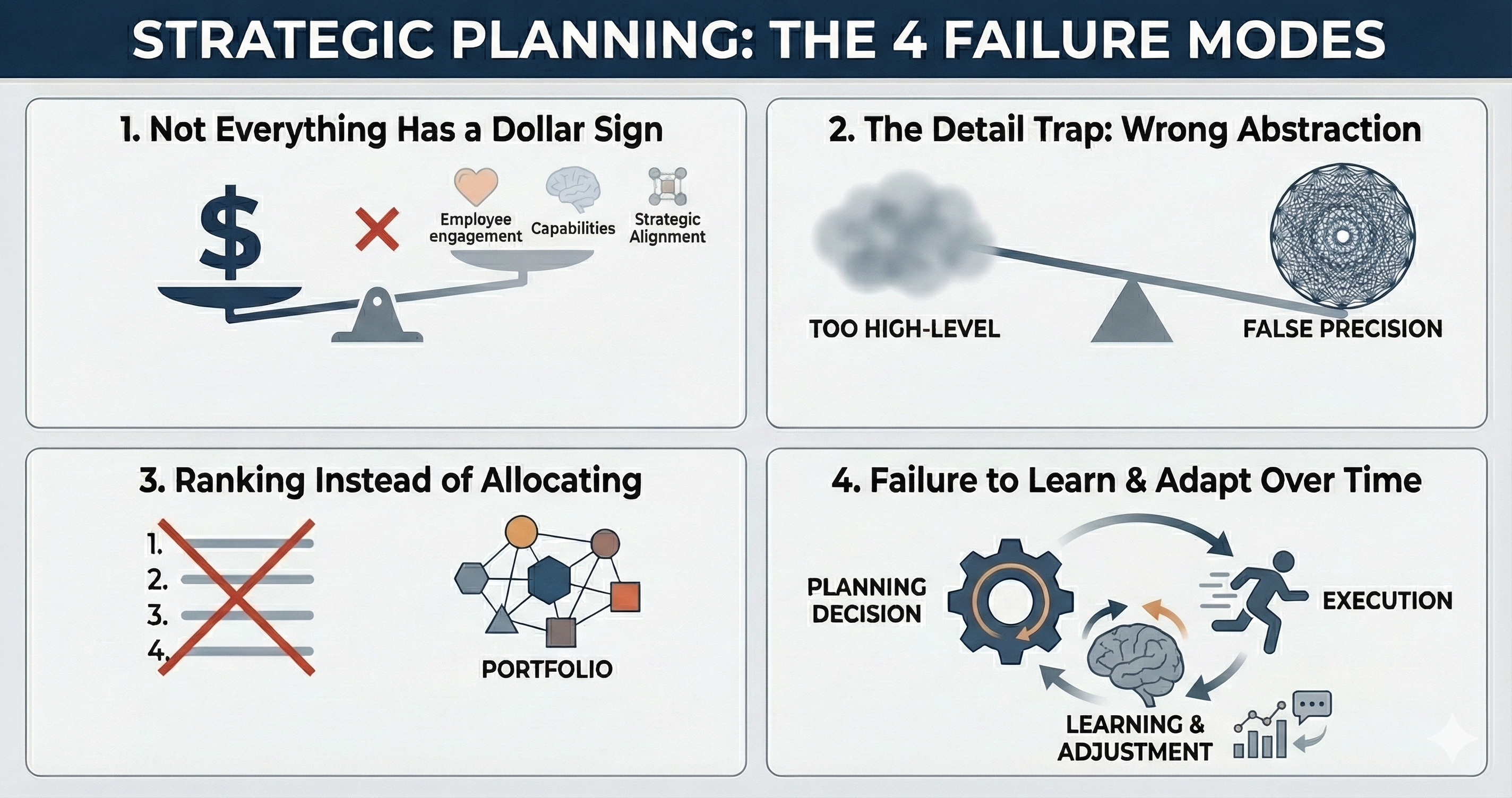
Failure Mode 1: Not Everything That Matters Has a Dollar Sign
Strategic planning forces trade-offs across fundamentally different kinds of value.
Some value is quantitative
- Cost reduction
- Margin Improvments
- NPS/Customer satisfaction scores
Some is quantitative or foundational
- Building internal capabilities
- Employee engagement
- Alignment with strategy
- Competitive or brand positioning
That difference matters, because value in strategy shows up:
- In different forms
- On different timelines
- Often only indirectly, with delays and contested causality
Only a subset of strategic value can be measured cleanly in dollars, and usually only after the fact.
Many planning processes respond by forcing everything into a single financial score or metric. That move creates the appearance of rigor while quietly biasing decisions toward whatever is easiest to quantify. Others allocate without measurement or only use the easily quantifiable metrics.
The result is predictable:
- Long-horizon investments lose to short-term efficiency
- Preventative and capability-building work gets underweighted
- Precision gets mistaken for understanding
The failure here isn’t lack of discipline.
It’s pretending that fundamentally different kinds of value are interchangeable.
Failure Mode 2: The Detail Trap — Too High-Level or False Precision
Strategic planning processes tend to fail at one of two extremes.
Some stay too high-level:
Real differences collapse into abstract scores or labels. Assumptions disappear. Trade-offs become invisible.
Others try to model the entire business:
The model expands until it mirrors the organization itself; every SKU, dependency, and micro-assumption included. Decisions slow to a crawl as it quickly becomes an excercise in challenging every single assumption, or worse, the model becomes a black box that no one understands except the business analytics team or LLM that built it.
Both mistakes look like rigor on the surface but neither supports good decisions.
Effective strategy lives in the middle.
At a level of abstraction that matches how leaders actually think:
- Strategic levers
- Directional bets
- Time horizons
- Sensitivities and trade-offs
At this level, predictive analytics can be generated with "white box" models that leadership teams actually understand.
The failure isn’t insufficient data.
It’s choosing the wrong level of abstraction for a forward-looking decision.
Failure Mode 3: Strategy Fails When You Rank Instead of Allocate
Many organizations fall into one of two allocation traps.
Some rely on pure bucketing:
Each function or initiative gets a fixed budget, and trade-offs across the enterprise never happen. Strategy fragments into disconnected bets.
Others rely on pure prioritization:
Everything is ranked in a single list, and funding flows from the top down. Interdependence, timing, and risk collapse into a linear score.
Both approaches avoid the hardest part of strategy.
Real strategy isn’t a list.
And it isn’t a set of independent budgets.
Strategy requires holding two views at the same time:
- Shaping a portfolio across risk profiles, time horizons, and intent
- Making explicit choices about what outranks what
That discipline requires understanding trade-offs using scenario modeling and predicitve analytics to optimize the decision.
When organizations don't model portfolios explicitly using scenario planning, organizations default to debate instead of decision — and call the outcome “strategy.”
Failure Mode 4: Decision Drift — When Decisions Are Just a Point in Time
Every strategy is a forward-looking bet.
If we make these investments, under these assumptions, within these constraints, we believe the business value of the outcomes are higher than the alternatives.
Those predictions are uncertain by definition.
They always will be.
The goal of strategy isn’t to be “right up front,” but to be directionally right and increasingly informed over time. That requires continuity between planning, execution, and learning.
Strategic planning decisions are probabilistic not deterministic. The goal isn’t to be 100% right 100% of the time. The goal is to be right often enough that the portfolio performs, and to update quickly when reality diverges from the bet.
But this only works if the strategic plan is treated as living and changeable. If we are going to be wrong some meaningful fraction of the time, it is critical to react and change course as soon as we sense it.
Most organizations treat strategy as a phase and execution as something that follows.
Once a plan is “approved”:
- Ownership fragments
- Budgets get reinterpreted
- Priorities shift
- People move
- Constraints change
The original decision logic does not travel with the work.
Tools preserve the outputs of strategy, lists, rankings, funding decisions, but they do not preserve:
- The assumptions that justified them
- The trade-offs that were consciously accepted
- The risks that were acknowledged
- The signals leaders expected to learn from
Execution continues, but strategy stops participating.
Without a learning loop:
- Deviations can’t be evaluated against the original bet
- New information can’t be translated into updated choices
- Feedback turns anecdotal instead of evidentiary
Improvisation turns into negotiation.
Negotiation turns into politics.
Politics gets labeled “alignment.”
The organization keeps moving, but it stops learning.
The Commitment Gap Is Where Strategy Loses Its Value
Across all four failure modes, the pattern is the same.
The problem isn’t process.
It isn’t governance.
It isn’t intelligence.
It’s the inability to turn insight into a committed choice — one that locks trade-offs, applies constraints, and aligns execution in a way that holds under pressure.
That gap between “we see the problem” and “we’ve made a decision that will stick” is where strategic value is lost.
Closing it requires treating strategic planning as what it actually is:
A decision process, not a document.
If you want the deeper walkthrough, including how organizations move from ad-hoc planning to explicit decision logic that carries through execution: the full Strategic Planning Decisions & Execution page lays it out in detail.