
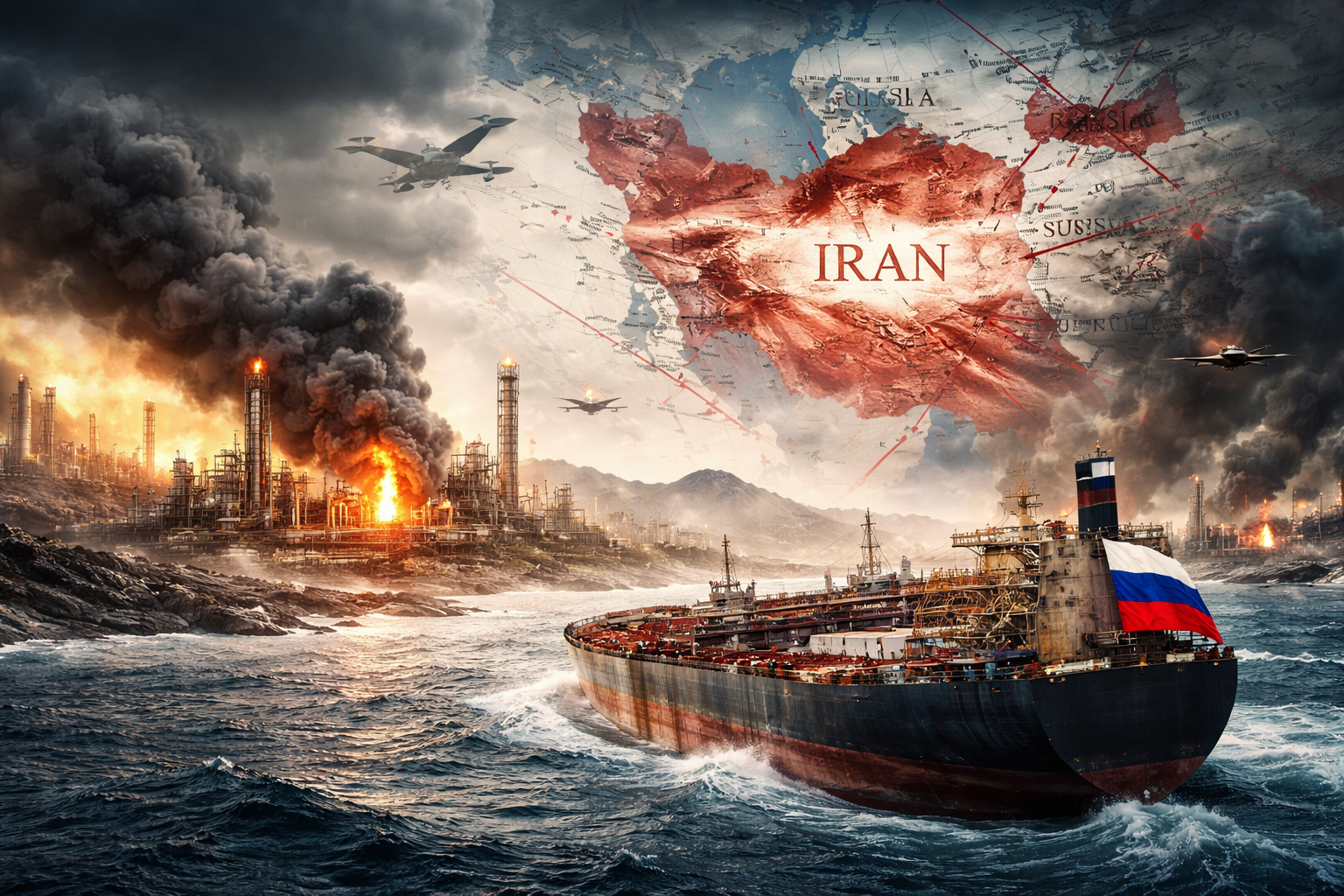
The U.S.-Israeli military operation against Iran that commenced on February 28, 2026, resulting in the killing of Supreme Leader Ali Khamenei and the closure of the Strait of Hormuz, has generated a cascade of geopolitical and geoeconomic signals that demand a structured assessment. At first glance, Russia appears to be a clear beneficiary: rising oil prices, Asian buyers returning to Russian crude, and Western attention diverted from Ukraine. But a Decision Intelligence lens, applied through the Decision Signal System, reveals a far more complex and dangerous landscape for Moscow. The conflict exposes Russia to sequential strategic attrition, operational vulnerabilities in its shadow fleet, escalating risks across its southern arc, and the paradox of short-term economic windfall masking long-term structural erosion. This article applies the four core functions of the Decision Signal System, identifying decision exposure, monitoring signal movement, testing assumptions, and raising decision pressure, to decode what Russia's Iran war calculus actually means for enterprise leaders, defense planners, and geopolitical strategists navigating the most volatile energy and security environment since 2022.
The Decision Signal System: Why This Moment Demands It
The Decision Signal System is a structured executive framework designed to support high-stakes decisions made under uncertainty, constraint, and time pressure. It exists because most strategy processes answer the wrong question, "What should we do if conditions hold?", when the real question is, "What do we do when they don't?" The system assumes instability as the baseline, visibility stays partial, and conditions shift faster than planning cycles.
In the current crisis, the signals are moving simultaneously across at least six domains: geopolitics, energy markets, military logistics, sanctions architecture, alliance cohesion, and regional security. No single-axis analysis, whether energy economics or military strategy, captures the full decision landscape facing Moscow or the enterprises exposed to its consequences. The Decision Signal System translates these cross-domain signals into decision-relevant insight by performing four functions: identifying where reversibility breaks down and capital locks in; monitoring curated indicators that change decision risk; testing assumptions embedded in live decisions against signal movement; and elevating decisions for governance review when thresholds are crossed.
Applied to Russia's Iran war calculus, this framework reveals that the assumptions undergirding Moscow's apparent advantage, energy leverage, Asian buyer dependence, and Western distraction are each weaker than they appear, while the risks, strategic depth erosion, operational vulnerability, and post-Soviet instability are structural and compounding.
Signal Domain One: The Illusion of Energy Leverage
The Surface-Level Narrative
The immediate energy signal seems unequivocally bullish for Russia. On February 28, when the first U.S.-Israeli strikes began, Brent crude was trading at roughly $72.87 per barrel. By March 4, it had surged past $82, a 13% increase driven by disruptions in the Strait of Hormuz, which normally handles approximately 20% of the world's seaborne oil and 20% of global LNG supply. QatarEnergy's unprecedented suspension of LNG production at Ras Laffan Industrial City, a facility accounting for roughly a fifth of global LNG supply, after Iranian drone attacks sent European gas prices surging as much as 54%. The Kremlin's Urals crude, which had fallen to a dismal $40 per barrel in late February under the weight of sanctions-driven discounts, climbed to approximately $57-$62 per barrel, surpassing the $59-per-barrel benchmark embedded in Russia's 2026 federal budget.
Russia's Deputy Prime Minister Alexander Novak declared that Russian oil is "in demand" and that the country is poised to increase supplies to China and India. Kirill Dmitriev, head of Russia's sovereign wealth fund, trolled European Commission President Ursula von der Leyen on social media, asking if she had a "backup LNG plan". On the surface, the energy windfall appears real and significant.
What the Signals Actually Reveal
But a disciplined application of signal monitoring exposes critical constraints that undermine this narrative. The first signal is production capacity. Russian oil firms had been reducing production for four months prior to the conflict, responding to shrinking cash flows amid falling prices and difficulty guaranteeing buyers. Ramping production back up would take time, and Russia would then run directly into OPEC+ production limits. The March 1 agreement among eight OPEC+ nations, including Saudi Arabia and Russia, authorized a production increase of only 206,000 barrels per day for April, greater than the 137,000 bpd initially expected but still a marginal response to the potential loss of Middle Eastern volumes. Russia's permitted share of this increase is approximately 62,000 bpd, bringing its total to roughly 9.64 million bpd, clearly insufficient to stabilize the market if Gulf supply were to drop significantly.
The second signal is the sanctions-discount trap. In late February, Urals crude from Russia's western ports was trading at its widest discount to Brent since April 2023, $28 to $30.62 per barrel on a Free-on-Board (FOB) basis. The outright Urals price at Primorsk had fallen to $42-44 per barrel even as Brent hovered near $72. State budget revenues from oil and gas had already dropped 24% in 2025 to the lowest level since 2020. While the conflict-driven price spike will narrow this discount, the G7 and EU price cap architecture makes it structurally unlikely that Urals will achieve parity with competitors. The market has shifted toward sellers, but Russia's sanctions burden means it captures only a fraction of the windfall that clean-barrel producers enjoy.
The third signal is China's discount expectations. Russia was already preparing to increase its Urals discount to Chinese buyers by $2-5 per barrel to maintain export volumes, potentially reaching $15 per barrel under delivered at the ship (DES) terms, after India began cutting purchases under U.S. pressure. Chinese imports of Russian crude were projected to reach a record 2.1 million barrels per day in February 2026, but analysts warn this pace is unsustainable. By April, smaller Chinese refineries may have accumulated sufficient inventories, leading to weaker demand and potentially forcing actual production cuts.
Decision Exposure Assessment
The assumption that higher global prices automatically translate into proportionally higher Russian revenues is the foundational error in the "energy leverage" thesis. Russia's price capture is structurally constrained by sanctions, insurance markets, and the shadow fleet logistics that enable its exports. As the Atlantic Council's Andrei Covatariu observed, "Moscow does not need to regain market dominance to gain leverage; it only needs to remain a marginal supplier in a tight system". That is a far more modest and precarious advantage than headlines suggest—and it is contingent on the conflict remaining short enough to boost prices without triggering the structural risks detailed below.
Signal Domain Two: The Asian Buyer Pivot
India: From Rejection to Necessity
India's relationship with Russian crude has become the most dynamic signal in the global oil market. In January 2026, India's Russian crude imports fell to approximately 1.1 million barrels per day, the lowest since November 2023, reducing Moscow's share of India's overall oil imports to just 21.2%. This was a direct consequence of a U.S. trade deal that rolled back punitive tariffs on Indian goods in exchange for reduced Russian oil purchases. President Trump claimed India had agreed to "stop buying Russian oil."
The February 28 strikes upended this calculus overnight. With approximately 40% of India's crude imports transiting the Strait of Hormuz, now largely inaccessible after Iranian strikes on vessels, India's world as the third-largest oil consumer suddenly became acutely vulnerable. Indian oil ministry officials acknowledged that reserves would last only two weeks. State refiners and government officials convened emergency weekend meetings to develop contingency plans, with options explicitly including Russian cargoes currently loitering near Indian waters.
Russia moved quickly to exploit the opening. An industry source told Reuters that approximately 9.5 million barrels of Russian crude are loaded onto vessels near Indian waters and could arrive within weeks. Russia signaled readiness to supply up to 40% of India's crude requirements, up from the current 30%, and also offered LNG supplies to replace halted Qatari deliveries. Indian refiners were reportedly calling on authorities to negotiate with Washington for permission to increase Russian imports.
China: Structural Dependence Deepens
China's exposure is equally significant but differently structured. As the world's leading crude oil importer, China obtains over 80% of its oil from Iran according to Kpler data, with roughly 30% of its LNG coming from Qatar and the UAE, and nearly 40% of its total oil imports passing through Hormuz. China's LNG reserves stood at 7.6 million tons as of late February, a buffer, but one that erodes quickly under sustained disruption.
With Gulf supply facing logistical risk and Venezuelan exports to China already constrained by U.S. enforcement actions, Russia's barrels become relatively more valuable to Chinese refiners. The Kremlin may not eliminate discounts overnight, but the leverage shift allows it to narrow them, protecting revenue at exactly the moment when higher headline prices already improve its fiscal outlook.
Assumption Test: Duration Dependency
The critical assumption underlying this apparent windfall is the duration of conflict. A Carnegie Russia Eurasia Center analyst assessed three scenarios: a rapid resolution returning Brent to ~$65 per barrel with no fundamental budget change for Russia; a moderate scenario with some shipping resuming and oil at ~$80, offering "some fiscal relief"; and a prolonged closure pushing oil to $108, yielding "the largest windfall for Russia" while potentially driving Europe toward recession. Russia's gains are directly proportional to the length of Hormuz disruption, a variable Moscow does not control.
Signal Domain Three: The Shadow Fleet Under Fire
A New Threat Vector
The sinking of the Arctic Metagaz, a Russian-flagged LNG carrier transporting 61,000 tons of LNG from Murmansk in the Mediterranean Sea between Libya and Malta on March 4, represents a qualitative escalation in the vulnerability of Russia's energy export infrastructure. Russia's Transport Ministry accused Ukraine of launching naval drones from the Libyan coast, while Putin personally labeled it "a terrorist act".
This incident marks the first confirmed sinking of an LNG tanker in the Russia-Ukraine conflict. While Ukraine had previously attacked Russian oil tankers near Turkey's Black Sea coast and struck a tanker in the Mediterranean in December 2025, the destruction of a large LNG carrier operating far from the conflict zone represents a dramatic expansion of the threat envelope. The Arctic Metagaz was under both U.S. and EU sanctions, identified as part of Russia's shadow fleet, the aging, often uninsured vessels that enable Moscow to bypass Western restrictions on energy exports.
Signal Implications for Decision Exposure
The shadow fleet has been Russia's primary mechanism for maintaining energy export volumes despite sanctions. It comprises older tankers with unclear ownership or insurance, processing millions of barrels per month for buyers in India, China, Turkey, and beyond. Ukraine's demonstrated ability to strike these vessels in the open Mediterranean, far from the Black Sea, fundamentally changes the risk calculus for any entity involved in Russian energy logistics. Insurance costs, which were already elevated due to the Iran conflict's disruption of the Strait of Hormuz, now face an additional premium layer from the proven threat of Ukrainian naval drone attacks in international waters.
This convergence, Iranian threats to shipping in the Persian Gulf and Ukrainian threats to Russian shipping in the Mediterranean, creates what the Decision Signal System would classify as a "compounding exposure," where two independent risk vectors amplify each other's effects on a single operational dependency: Russia's ability to move hydrocarbons to market.
Signal Domain Four: Strategic Depth Erosion
The Sequential Attrition Pattern
Chatham House's analysis frames Russia's core strategic dilemma with precision: the war in Iran risks "sequential attrition of strategic depth". Russia's Middle Eastern posture was historically supported by layered, strategically complementary partnerships, with Syria as a western anchor and Iran as an eastern axis. That layering has collapsed. Russia lost effective influence in Damascus when Bashar al-Assad fled to Moscow in November 2024. It watched passively as U.S. forces seized Nicolás Maduro in Venezuela in January 2026. It could not deter the U.S.-Israeli strikes on Iran despite staging joint naval exercises with Tehran and Beijing.
As Brookings' Steven Pifer cataloged, the pattern is now unmistakable: "In December 2024, Moscow stood meekly by as Assad fell. In June 2025, Russia called the U.S. strike on Iranian nuclear facilities 'an unprovoked act of aggression' but took no action. In January, when U.S. forces seized Maduro, Russia expressed 'strong solidarity' but did nothing meaningful". Each instance of demonstrated impotence further erodes the credibility of Russian security guarantees, precisely the currency Moscow trades on in the post-Soviet space.
The Multipolar Narrative Under Strain
Russia's grand strategic conception, articulated by former Prime Minister Yevgeny Primakov in 1998 and maintained as policy ever since, rests on a narrative of a multipolar world order in which powers such as Iran, China, and Russia balance perceived Western hegemony. The war in Iran tests this narrative directly. If the U.S. and Israel succeed in degrading Iran's strategic position, "the narrative of a resilient multipolar order loses ideological traction". The normalization of preventive strikes against nuclear infrastructure further erodes the diplomatic architecture Russia once used to project influence and political legitimacy.
For enterprise leaders assessing geopolitical risk, this is not an abstract concern. The erosion of Russia's multipolar framework undermines the stability of partnership networks across Central Asia, the Caucasus, and the broader Global South on which many multinational supply chains depend.
Nuclear Dimensions and Rosatom Exposure
Russia's operational exposure in Iran extends to the nuclear domain. Rosatom CEO Alexei Likhachev warned on March 4 that the Bushehr nuclear power plant, Iran's sole operational nuclear facility, built by Russia, faces growing threats as explosions are heard "just kilometres away from the station's defense line". Rosatom has evacuated 94 non-essential personnel, with 639 Russian staff remaining in-country, and suspended construction on Bushehr's second and third reactor units. Likhachev acknowledged that communication with the leadership of the Iranian nuclear industry had been severed, though contact with on-site colleagues remains.
A strike on Bushehr, even inadvertent, would spread radioactive contaminants and create a crisis that directly involves Russian citizens, Russian state assets, and Russia's credibility as a nuclear technology partner globally. This represents a non-linear risk that no increase in energy revenue can offset.
Signal Domain Five: Economic and Supply Chain Exposure
The Reverse Dependency Problem
A critical but underappreciated signal is Russia's own economic vulnerability to disruptions in the Middle East. After years of pivoting away from the West, Moscow has built economic dependencies on countries now directly or indirectly involved in the conflict. Iran and several Arab countries serve as transit points for Russian trade, and disruptions could generate shortages of goods ranging from agricultural products, such as cucumbers, for which Iran supplies as much as 20% of Russia's imports, to technological goods flowing through parallel import channels via the Persian Gulf.
Russian oil exports themselves face exposure. Russia has increased supplies to refineries such as Ruwais in the UAE and has become more reliant on Fujairah, the Middle East's largest oil trading hub, amid logistics difficulties with its shadow fleet. If these hubs face operational disruptions from Iranian missile and drone attacks, Saudi Arabia has already shut operations at the Ras Tanura refinery after intercepting Iranian drones. Russia's own export logistics suffer.
European Gas Dynamics: Leverage or Trap?
The European dimension presents an apparent windfall that may prove illusory. European gas storage levels are below 30% after a harsh winter, and below-average snow cover in Southern and Central Europe means reduced hydroelectric generation—thereby increasing gas-fired power generation precisely when Europe needs to refill storage. EU rules requiring approximately 90% storage capacity to be full ahead of winter create an unforgiving injection timeline. Even if the conflict lasts only the four to five weeks President Trump initially estimated, that window overlaps with early injection season, enough to reshape summer price curves.
Putin has floated the possibility of halting gas supplies to European markets entirely and redirecting exports to "more promising" buyers if European sanctions take full effect later this year. The U.S. decision to indefinitely exempt Rosneft's German subsidiary, which operates the PCK Schwedt refinery that supplies approximately 90% of fuel to Berlin and the Brandenburg region and roughly 12% of Germany's total fuel, from sanctions underscores the leverage Russia retains.
Yet this leverage carries a structural trap. If the energy crisis forces Europe to backtrack on its Russian gas phaseout—delaying implementation deadlines, granting temporary exemptions, or extending transitional contracts—Moscow achieves something durable: restored leverage over European energy security. But if Europe responds by accelerating diversification, strengthening demand flexibility, and maintaining political unity, the shock ultimately reinforces the strategic resilience that permanently diminishes Russian influence. The outcome depends on European political cohesion, another variable Moscow cannot control.
Signal Domain Six: Military Logistics and the Ukraine War
The Patriot Missile Equation
The diversion of Western military resources to the Middle East creates a tangible, quantifiable impact on Ukraine's defense. Since the strikes on Iran began, Tehran has launched hundreds of ballistic missiles and drones against Gulf states, the majority intercepted using PAC-3 Patriot missiles—the same interceptors Ukraine depends on to shield critical energy sites and military facilities from Russian ballistic attacks.
Lockheed Martin currently produces roughly 600 PAC-3 missiles annually, a figure that already falls short of covering combined demand from the U.S., Gulf allies, and Ukraine. While production is scaling to 2,000 annually under a January 2026 deal, that capacity will come too late to address shortages this year. Ukrainian President Zelensky has openly warned of "difficulty obtaining missiles and weapons to defend our skies," while Ukraine has offered Middle Eastern states its anti-drone systems in exchange for air defense missile systems.
Russia fires 70 to 85 ballistic missiles per month against Ukraine, according to Ukrainian data, with over 700 launched during the most recent winter campaign targeting Ukraine's energy grid. A senior Pentagon official acknowledged production-related delays and warned that "constraints could deepen in the event of a prolonged conflict". Two European diplomats expressed concern that delivery timelines under NATO's Prioritized Ukraine Requirements List (PURL) could slip further as the U.S. prioritizes its own needs.
Russia's Domestic Military Production Independence
Critically, the war in Iran is unlikely to directly hinder Moscow's military operations in Ukraine. Chatham House assesses that Russia has already internalized production of weapons systems it once sourced from Tehran. Iranian Shahed drones and components, once critical stopgaps, have been integrated into Russian production lines. Russia now produces substantial quantities of similar systems domestically. This reduces short-term operational risk for Moscow should the situation in Iran become protracted. Russia can absorb Iranian instability without an immediate collapse of its capabilities.
However, Iran's reduced capacity to serve as a military supplier carries longer-term implications. The €500 million arms deal signed in December 2025, committing Russia to deliver 500 Verba man-portable air defense launchers and 2,500 9M336 missiles to Iran in three tranches from 2027 to 2029, was designed to rebuild ties after Moscow refused to aid Tehran during prior Israeli strikes. If the war continues and Iran remains under bombardment, demand from Tehran could help sustain Russia's military-industrial complex post-Ukraine, providing revenue and production-line continuity. But deliveries cannot begin until the war in Ukraine concludes, making this a conditional rather than an immediate benefit.
Signal Domain Seven: The Post-Soviet Space Under Pressure
Central Asia and Caucasus Instability
The most structurally consequential risk for Russia may be in its own near abroad. The conflict raises the possibility that Central Asian and South Caucasian states, regions that Russia considers its sphere of influence, could become targets of Iranian retaliation due to increased engagement with the U.S. and its military.
Signal indicators are already flashing. In mid-February, two U.S. military transport aircraft, a C-17A Globemaster III and an MC-130 Super Hercules, were spotted in Turkmenistan, echoing Washington's use of Turkmen infrastructure for transit and refueling during the Afghanistan war. Approximately 20 U.S. military transport aircraft arrived in Armenia and Azerbaijan shortly before Vice President JD Vance visited both countries. Open-source tracking data showed a Boeing 787-8 Dreamliner departing from the U.S. base at Andrews Air Force Base, transiting through Russian airspace, and landing in Kazakhstan. More than 300 U.S. military aircraft are now deployed to Central Command.
Kazakhstan's positioning illustrates the diplomatic minefield. President Kassym-Jomart Tokayev neither immediately condemned the U.S. and Israel for attacking Iran nor expressed condolences to the Iranian leadership over Khamenei's death. For a country that has historically pursued strict neutrality between great powers, this silence is itself a signal, indicating Astana's calculation that aligning with Washington carries a greater risk of Russian displeasure but offers greater security guarantees than aligning with Tehran.
The Refugee Vector
A prolonged conflict introduces refugee flows as a destabilizing variable. Armenia and Azerbaijan collectively share more than 700 kilometers of border with Iran, and ethnic Armenians and Azerbaijanis make up roughly a quarter of Iran's 92 million-person population. Armenia also risks losing 10-15% of its natural gas supply, which comes from Iran. Russia, whose southern flank security strategy has historically relied on regional stability, faces the prospect of instability across the entire Caucasus-Central Asia arc at a moment when its own military and financial capacity is depleted by four years of war in Ukraine.
The CSTO, Russia's military alliance comprising Russia, Belarus, Armenia, Kazakhstan, Kyrgyzstan, and Tajikistan, has already identified the Tajikistan-Afghanistan border as a major security flashpoint, with up to 23,000 terrorist fighters reportedly in Afghanistan posing cross-border threats. The war in Iran adds a new vector of instability to an already fragile regional architecture.
Decision Signal Synthesis: Russia's Narrow Window
Assumption Mapping
The Decision Signal System requires explicit mapping of assumptions against signal movement. For Russia's Iran war calculus, the critical assumptions and their current status are:
Assumption Signal Status Assessment
Higher oil prices translate to proportionally higher Russian revenue. Weakening: sanctions discount constrains price capture; G7/EU price cap limits upside
Revenue benefit is real but structurally capped
Asian buyers (India, China) will absorb additional Russian supply. Strengthening short-term: India actively seeking Russian crude; 9.5M barrels positioned near Indian waters
Duration-dependent; U.S. trade pressure remains a constraint
Western attention diverted from Ukraine aids the Russian military position. Mixed: Patriot missile supply chain under strain, but European allies maintaining Ukraine commitments
Net marginal benefit is not decisive
Russia can exploit energy leverage fto secure sanctions relief. Weakening: no precedent from prior escalations; the 2025 Twelve-Day War yielded no sanctions relief
Low probability without a Ukraine ceasefire breakthrough
Iran remains a viable strategic partner and regional anchor. Deteriorating: regime under existential pressure; Bushehr at risk; communications severed
Sequential attrition of strategic depth is accelerating
Post-Soviet sphere of influence remains stable under stress, U.S. military activity in Central Asia Increasing; Kazakhstan diplomatically hedging
Escalation potential is high if the conflict is protracted
Where Reversibility Breaks Down
The Decision Signal System's first function, identifying decision exposure, directs attention to where reversibility breaks down. For Russia, the irreversible thresholds are:
- Shadow fleet attrition: Each vessel destroyed or deterred from operating represents a permanent reduction in sanctions-evasion logistics capacity that cannot be quickly replaced. The Arctic Metagaz sinking establishes Ukraine's capability to strike LNG carriers in the open Mediterranean.
- Strategic partner loss: If Iran emerges from the war significantly enfeebled or forced into a coercive settlement with Washington, Moscow permanently loses leverage in a region where its room for maneuver has already significantly narrowed after the fall of Assad.
- Multipolar narrative collapse: Each instance of demonstrated Russian impotence in the face of U.S. military action against allies, Syria, Venezuela, Iran, erodes the credibility of the multipolar framework on which Moscow's Global South partnerships depend. This is cumulative and difficult to reverse.
- Post-Soviet realignment: If Central Asian and Caucasian states deepen security engagement with Washington during the crisis, the institutional pathways created (base access agreements, joint exercises, intelligence sharing) tend to persist even after the immediate crisis recedes.
When Decision Pressure Rises
The Decision Signal System's fourth function, raising decision pressure at the right moment, identifies the triggers that should escalate enterprise and policy decisions from monitoring to active response:
- Hormuz closure exceeding two weeks: Transforms the oil price shock from a spike to a structural repricing, potentially pushing Brent above $100 and triggering European recession dynamics.
- Second shadow fleet attack: Establishes a pattern rather than an incident, fundamentally repricing maritime insurance for Russian energy exports and potentially stranding volumes.
- Bushehr incident: Any radiological event involving Russian personnel would create a crisis transcending energy markets, forcing Moscow into direct confrontation with the U.S.-Israeli coalition or public capitulation.
- Iranian attacks on Central Asian infrastructure would trigger CSTO obligations and force Russia to choose between defending allies with depleted military resources and further demonstrating its inability to project power.
- European policy reversal on Russian gas phaseout: Would signal that Moscow has restored durable leverage, the most strategically significant outcome it could extract from the crisis.
Implications for Enterprise Decision-Makers
Energy-Exposed Enterprises
Organizations with energy procurement, logistics, or downstream operations should treat the current price environment as structurally unstable rather than trending in either direction. The convergence of Hormuz disruption, QatarEnergy's production suspension, and shadow fleet vulnerability creates a supply-side compression that cannot be resolved by OPEC+ production adjustments alone. Procurement strategies should factor in a potential prolonged two- to three-tier pricing environment in which clean-barrel (non-sanctioned) crude commands a significant premium over Russian and Iranian grades.
Supply Chain Risk
Companies with supply chain exposure to the Persian Gulf, whether for energy inputs, manufactured components, or transshipment, face a compounding risk of disruption. The combination of Iranian retaliatory strikes against Gulf state infrastructure, Hormuz shipping restrictions, and the broader military conflict creates a disruption profile significantly more severe than the 2022 Russia-Ukraine energy shock, which primarily affected European pipeline gas.
Defense and Aerospace
The Patriot missile production bottleneck creates ripple effects for defense procurement timelines globally. Any organization involved in defense logistics, alliance burden-sharing, or critical infrastructure protection in Europe should assess the probability that U.S. air defense priorities shift toward the Middle East for the duration of the conflict, creating delivery delays for committed European and Ukrainian systems.
Geopolitical Risk in Post-Soviet Markets
Enterprises operating in Central Asia or the Caucasus should monitor the pace and character of U.S. military engagement in the region, the diplomatic positioning of host governments between Washington and Moscow, and any signs of Iranian retaliatory targeting of states hosting U.S. assets. The historical preference for neutrality in these regions is being stress-tested in real time, and the institutional outcomes, new basing agreements, security partnerships, and intelligence arrangements will reshape the operating environment for years beyond the current crisis.
Narrow Windows, Asymmetric Risks
Russia's Iran war calculus is not, as the surface-level narrative suggests, a story of opportunistic gain. It is a case study in the difference between tactical windfall and strategic exposure, and the Decision Signal System exists precisely to draw that distinction before capital commits and options close.
Moscow will capture some energy revenue in the short term. It may see India and China return as more willing buyers of crude. It may watch as Patriot missiles flow east instead of to Kyiv. But these are gains measured in weeks and months, contingent on conflict duration that Russia does not control, constrained by sanctions architecture that the war is unlikely to dismantle, and offset by structural risks, shadow fleet attrition, strategic partner loss, post-Soviet realignment, multipolar narrative erosion, that are cumulative, difficult to reverse, and accelerating.
As Chatham House concludes, Russia is "exposed to the broader geopolitical turbulence that Iran's war creates. The war tests Russia's strategic patience, ideological narrative, and capacity to maintain agency in a rapidly fragmenting region". The partnership of convenience that once served as a buffer is now a variable in a much larger equation, one where Russian influence is "neither pre-eminent nor entirely optional. It is contingent, negotiated, and increasingly vulnerable to shifts far beyond Moscow's direct control."
For leaders operating under the Decision Signal System discipline, the instruction is clear: identify which of your decisions depend on assumptions about Russian energy leverage, Asian buyer behavior, European policy cohesion, or post-Soviet stability, and stress-test each against the signal movements documented here. The window is narrow. The risks are asymmetric. And the assumptions are decaying faster than the planning cycle.