
The most expensive mistakes in executive decision-making are rarely made in moments of visible crisis.
They are made months or years earlier, when the first credible signals appear and leadership teams systematically dismiss them.
The intelligence is accurate
The data exists
The warnings are present
And yet organizations continue along paths that later prove at best misguided and at worst catastrophic.
This is not an intelligence failure.
It is a decision failure.
More precisely, it is a failure of decision psychology and decision architecture — a failure to design decisions that can absorb early signals, adapt to changing conditions, and overcome the human tendency to defend yesterday’s commitments.
Scenario modeling, properly implemented within Decision Intelligence (DI), exists to address this failure.
The deeper problem: intelligence and strategy are decoupled by design
This failure mode is the starting point of the Executive Intelligence Framework (EIF).
EIF begins with a blunt observation:
modern enterprises are structurally built to separate knowing from deciding.
Intelligence lives vertically.
It flows up functions.
It is owned by analysts, planners, researchers, and domain experts.
It looks backward by default, measuring what has already happened and extrapolating from it.
Strategy lives horizontally.
It cuts across capital, operations, technology, talent, and markets.
It is inherently forward-looking.
It requires making commitments under uncertainty.
These two systems rarely meet in a disciplined way.
Intelligence seeks certainty.
Strategy requires risk.
So intelligence is summarized, packaged, and presented — not continuously embedded into the decisions that actually commit capital, resources, and time.
EIF exists to fix this broken plumbing.
It is not a dashboard.
It is not a planning framework.
It is a decision operating model designed to reconnect intelligence and strategy before volatility turns insight into hindsight.
SnapStrat Decision Intelligence is the system that operationalizes this model.
The commitment gap under volatility
Most organizations believe the commitment gap is an execution problem. It often is not.
Execution fails because decisions are made as if:
- The future is stable
- Intelligence will be acted on when it “really matters”
- Leaders will pivot rationally when conditions change
None of these assumptions hold under real-world volatility — especially geopolitical volatility.
In practice:
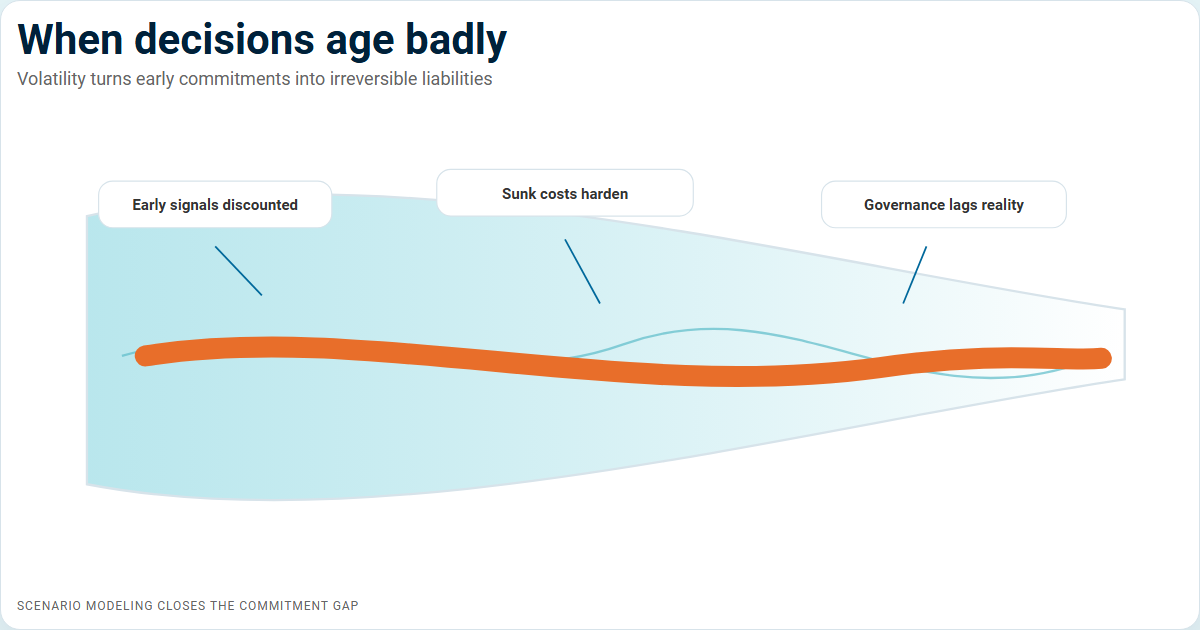
- Early signals are discounted
- Intelligence that challenges existing strategy triggers resistance
- Capital sticks to prior commitments long after their rationale has eroded
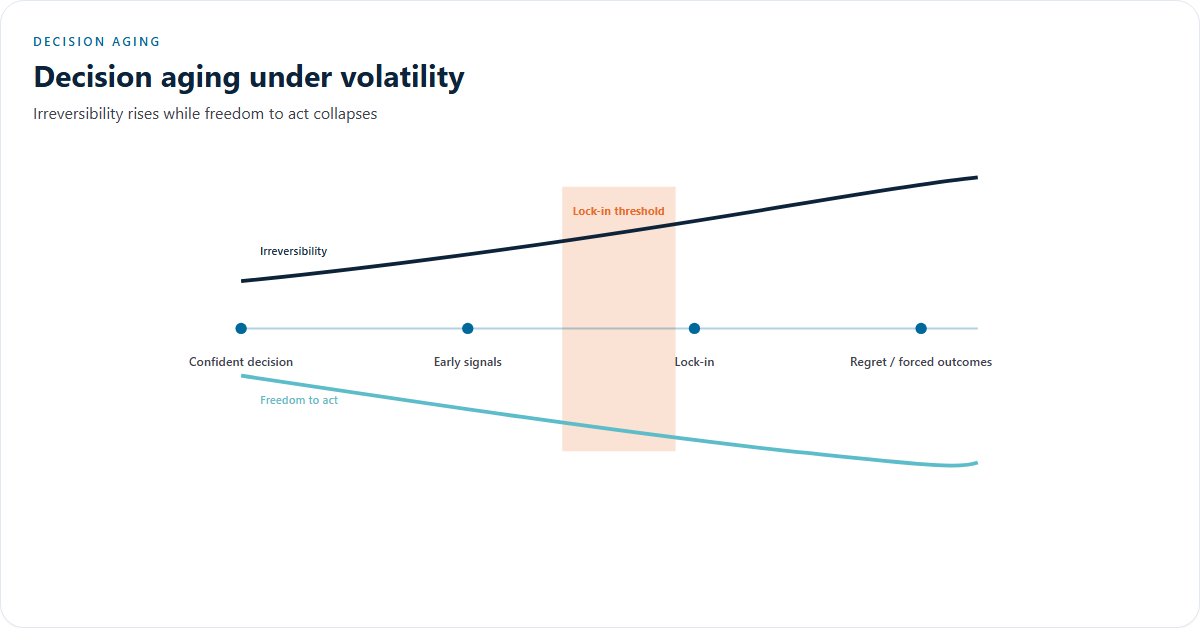
The commitment gap is the space between knowing change may be required and being structurally able to act on that knowledge.
EIF names this as action inertia — not ignorance, not incompetence, but an organizational inability to move once commitments harden.
Scenario modeling closes that gap, not by predicting the future, but by making future decisions explicit before psychology, politics, and sunk costs take over
What scenario modeling means in Decision Intelligence
Scenario modeling in DI is not about storytelling or forecasting.
It is about testing decision validity under alternative futures while the organization still has freedom to act.
Specifically, scenario modeling allows leadership teams to:
- Hold the decision logic constant
- Vary external and internal assumptions
- Observe how optimal actions, trade-offs, and risks shift
- Pre-commit to how decisions will adapt when signals change
This is where DI directly operationalizes EIF.
EIF reframes intelligence from a challenge to existing strategy into an expected input to continuous strategic adjustment.
DI turns that reframing into mechanics, asking the question:
“How does this decision evolve as conditions change?”
That shift dramatically reduces status quo bias and political resistance.
The two distinct jobs scenarios perform — and why conflating them causes failure
Scenario modeling in DI serves two fundamentally different purposes. Treating them as one is a category error.
- Trade-off exploration (internal choice)
Here, scenarios help leaders understand the consequences of their own decisions. The environment is assumed to be relatively stable.
The allocation choices change. This is where criteria and constraints do most of the work.
Examples:- How should available capital be allocated across projects
- What trade-offs exist between near-term return and long-term optionality
- How does prioritizing resilience affect growth
- Risk and exposure analysis (external uncertainty)
Here, the decision structure is fixed, at least provisionally, and the world moves.
Examples:- Geopolitical escalation affecting supply chains
- Regulatory or trade policy shifts
- Sanctions, tariffs, export controls
- Energy, commodity, or FX volatility
This is where assumptions dominate.
EIF is explicit about this distinction:
most failures occur not because organizations fail to see risk, but because they lack pre-agreed decision responses when risk materializes.
Scenario modeling provides those responses.
The three building blocks of a DI scenario
Every scenario in Decision Intelligence is built from three elements. Precision matters.
- Assumptions: sources of uncertainty
Assumptions are inputs the organization does not control. This directly addresses EIF’s critique of dashboards: lagging indicators are too late. Signals must surface before commitments become irreversible.
Assumptions must be tied to observable signals.
If an assumption cannot be monitored, it cannot be acted on
Assumptions may be:- Geopolitical (conflict escalation, sanctions, trade fragmentation)
- Regulatory (policy shifts, enforcement timing)
- Macroeconomic (inflation, rates, FX)
- Internal but exogenous (capacity ramp speed, supplier reliability)
- Criteria: what “good” means
Criteria define what the decision optimizes for. Changing criteria weights across scenarios is used to test sensitivity of any specific criteria so we really understand the trade-offs we are making
Examples:- Portfolio NPV
- Strategic alignment
- Risk concentration
- Resilience and optionality
- Speed to recover under shock
- Constraints: what cannot be violated
Constraints impose discipline. They may be hard (regulatory limits, liquidity floors), or soft (risk appetite, budget limits)
Hard constraints do not change across scenarios, soft constraints will allowing us to test what will change if some constraints are loosened or tightened.
If constraints are fuzzy, decisions become theory-crafting, producing recommendations that can not survive in the real world, exactly the failure mode EIF highlights.
How a scenario is reflected in DI
A scenario is a coherent set of assumptions applied to a fixed decision structure, used to evaluate how decisions perform under different futures.
Scenarios do not redefine decisions.
They stress-test them.
Outputs of scenarios may be deterministic or probabilistic. Deterministic scenarios are yes/no, they produce a single result based on a set of assumptions, criteria and constraints.
Probabilistic scenarios produce a range of outcomes with a probability attached to each one, based on a probability assigned to specific assumption or set of assumptions keeping constraints and criteria fixed. Probabilistic scenarios are useful for testing outlier geopolitical or macroeconomic assumptions to understand the risks they create.
A well-structured set of scenarios is how geopolitical and market intelligence is converted into action rather than debate.
A concrete example: recurring capital allocation under geopolitical risk
The commitment gap is most dangerous in recurring strategic decisions, not one-time bets.
The decision
Allocate $250M of available capital each year across a portfolio of initiatives over a rolling three-year horizon.
Projects may include:
- Capacity expansion in different regions
- Supply chain diversification
- Automation and productivity investments
- New market or product entry
- Resilience and redundancy initiatives
This decision is revisited continuously — but rarely redesigned.
How this is usually decided
Most organizations run an annual ritual:
- Projects submit business cases
- Finance normalizes NPVs
- Leadership ranks initiatives
- Capital is allocated
This appears disciplined.
It is not.
The process assumes relative project attractiveness will remain stable as geopolitical, regulatory, and macro conditions evolve. That assumption is false.
Where the commitment gap opens
As the year unfolds:
- Trade policy changes alter cost structures
- Sanctions or export controls emerge
- Financing conditions tighten or loosen
- Supply chain disruptions limit output of certain products
Leadership now knows something has changed — but lacks pre-agreed rules for reallocation.
Capital sticks to legacy commitments, sunk cost bias escalates investment and the confidence and outcomes of the portfolio degrade
The intelligence exists but the organization hesitates.
EIF calls this escalation of commitment amplified by structure.
How scenario modeling changes recurring capital allocation
Step 1: Fix the decision logic
Before scenarios, the structure must be explicit.
Choices
- Allocate capital across initiatives
- Adjust funding levels
- Pause, defer, or exit projects
Criteria
- Portfolio value
- Strategic exposure
- Risk concentration
- Optionality under uncertainty
Constraints
- Annual capital availability
- Liquidity thresholds
- Regulatory commitments
- Minimum sustainment spend
This structure persists.
The decision is re-run, not reinvented.
Step 2: Define scenarios as assumption sets tied to signals
Scenarios represent shifts in the environment, not changes in preference.
Examples:
- Base geopolitical continuation
- Regional escalation and trade fragmentation
- Regulatory tightening or sanctions
- Financing constraint tightening
Signals might include policy announcements, freight costs, energy prices, supplier lead-time variance, or credit spreads.
If you cannot detect the change, you cannot respond deliberately.
Step 3: Generate scenario-conditioned allocation patterns
Instead of a single “optimal” portfolio, the model produces scenario-conditioned allocation patterns.
For example:
- Under escalation → shift capital toward resilience and redundancy
- Under sanctions → deprioritize exposed regions
- Under financing stress → favor faster-payback initiatives
This enables something most organizations never do:
Pre-commit to how capital will move when conditions change.
Reallocation becomes execution — not admission of failure.
Why this works: EIF’s psychology, DI’s mechanics
EIF explains why organizations fail:
- Status quo bias favors inertia
- Escalation of commitment rewards doubling down
- Political risk suppresses uncomfortable signals
SnapStrat Decision Intelligence explains how to intervene:
- Decisions are treated as testable hypotheses
- Intelligence is embedded continuously, not episodically
- Adjustment is normalized rather than stigmatized
Intelligence no longer challenges strategy.
It informs the next iteration.
That framing reduces resistance, accelerates response, and limits escalation behavior.
Summary
Scenario modeling does not prevent shocks.
It prevents organizations from being surprised by changes they already saw coming.
EIF diagnoses the failure.
SnapStrat DI provides the operating system.
Scenario modeling is the bridge between intelligence and action.
The intelligence has always been present.
The question is whether the organization is designed to act on it