
SnapStrat
Decision Signal System | Geopolitical Risk Assessment
Mali and the Sahel
A Systems-Level Warning Signal for West Africa
July 2026
Key Judgments
Mali no longer functions as an isolated national crisis. It serves as the leading indicator of the political-security trajectory in West Africa. Security, governance, and humanitarian conditions within the country point to accelerating fragmentation, deepening disruptions in corridors, and rising regional spillover risk over the next two quarters. Managed deterioration is the base case. Stabilization is the low-probability outcome.
In the 1990s, Mali stood as proof that a democratic transition could hold in a difficult security and development environment. In 2026, it stands as the opposite case. Democratic erosion, weak governance, and failed militarized stabilization are simultaneously accelerating state fragmentation and regional contagion.
This assessment follows ICD-203 tradecraft standards. Judgments are separated from evidence. Confidence levels are stated explicitly. Alternative explanations are considered. Indicators that would change the assessment are identified below.
Key Judgment 1: Mali's trajectory is worsening
Mali's security and governance environment is likely to continue to worsen over the next three to six months. The state will face episodic territorial reversals, continued pressure on the Bamako-Kati core, and mounting insecurity in corridors.
Confidence: Moderate. Multiple independent monitoring streams converge on deterioration, but verification inside contested areas stays constrained. Coordinated attacks in late April 2026 and sustained pressure on northern and central zones point toward a conflict system that is becoming more synchronized and harder for the state to contain.
Key Judgment 2: JNIM is dominant, not exclusive
JNIM is highly likely to remain the dominant strategic armed actor in Mali, though not the only consequential one. JNIM combines military operations, coercive local governance, and corridor pressure with expansion into newly vulnerable geographies.
Confidence: Moderate to high. ISSP and Tuareg armed actors are likely to remain capable of exploiting the same state weaknesses even where they don't drive the national threat picture. The significance of April's coordinated violence isn't that violence increased. It's that multiple anti-state actors demonstrated the ability to impose overlapping stress on the regime, the military, and core transport networks simultaneously.
Key Judgment 3: Mali as regional bellwether
Mali has shifted from a symbol of democratic success to a leading indicator of regional democratic and security decline. Mali doesn't predict Africa's future path as a continent. It occupies a sentinel position because it shows what happens when democratic breakdown, weak service delivery, insurgent expansion, and externalized security responses reinforce each other.
Confidence: Moderate. This interpretation is inferential rather than directly observed, but it holds up against sustained institutional decline data and the convergence of independent analytical views.
Key Judgment 4: Western positioning is shifting
Western governments are increasingly likely to view Mali through a dual lens of security threat and governance failure rather than as a transitional partner. Future engagement is increasingly framed around measurable political benchmarks, institutional legitimacy, civilian protection, and governance outcomes rather than transition rhetoric.
Confidence: Moderate. Western positioning isn't monolithic, but the trend runs toward conditionality. A parallel and partly offsetting trend is evident: some Western policy circles are shifting from a democracy-first framing toward a strategic-competition and commercial-interest framing across Africa, a shift that risks diluting consistent pressure for democratic restoration.
Purpose and Scope
This assessment covers Mali and the wider Sahel as of July 2026. It sets out confidence-calibrated judgments, a risk signal grid, scenario analysis, and a decision-recommendations annex. The purpose is executive decision support, not advocacy. The scope covers what is happening, why it matters to decision posture, and what would change the assessment.
Tradecraft follows ICD-203 standards: objectivity, expression of uncertainty, separation of assumptions from evidence, and explicit identification of indicators that would alter judgments. Risk governance follows an integrated enterprise risk model spanning identification, assessment, treatment, monitoring, communication, and governance escalation across strategic, operational, humanitarian, compliance, and reputational domains. Country-level snapshots aren't sufficient for a risk environment this fragmented. The system requires a continuous monitoring architecture.
Current State: Mali
Security Environment
Mali's security environment is deteriorating in both geographic breadth and strategic depth. The late-April 2026 attacks reached Bamako, Kati, Gao, Mopti, and Sévaré. The threat is no longer confined to remote northern or central battle spaces.
This shift reflects campaign-level coordination and expanding anti-state reach, not sporadic insurgent activity. The pattern signals a more mature insurgent capacity to generate simultaneous political, military, and psychological effects against the state.
The state retains formal sovereignty and control over core institutions. Effective territorial control is fragmented and highly uneven. Nominal government authority increasingly masks weak real control over routes, communities, and peripheral towns.
Governance and Legitimacy
Mali's democratic trajectory has deteriorated sharply since the coups of 2020 and 2021. The current political order runs on militarized control rather than a credible democratic transition. Democratic performance metrics show low-range results across representation, rights, and the rule of law. The dissolution of political parties and the abandonment of the transition deadline stand as critical indicators of democratic regression.
The deeper problem extends past procedural democracy loss into legitimacy erosion. Public confidence in democratic governance has weakened significantly. Younger populations across the region show growing openness to military rule where civilian institutions look ineffective, corrupt, or unable to deliver security and welfare.
Humanitarian and Civilian-Protection Conditions
The humanitarian outlook stays severe and continues to worsen under the combined weight of conflict expansion, IED proliferation, restricted access, and coercive governance by armed groups. Across the central Sahel, violence by both armed Islamist groups and state security actors continues to threaten populations, with credible risk that conduct on both sides amounts to war crimes or crimes against humanity.
In practical terms, communities face double exposure: insurgent violence and extortion on one side, abusive or indiscriminate counterterrorism on the other. For decision-makers, that dual exposure poses legal, reputational, humanitarian, and partner-integrity risks simultaneously.
Economic and Operating Environment
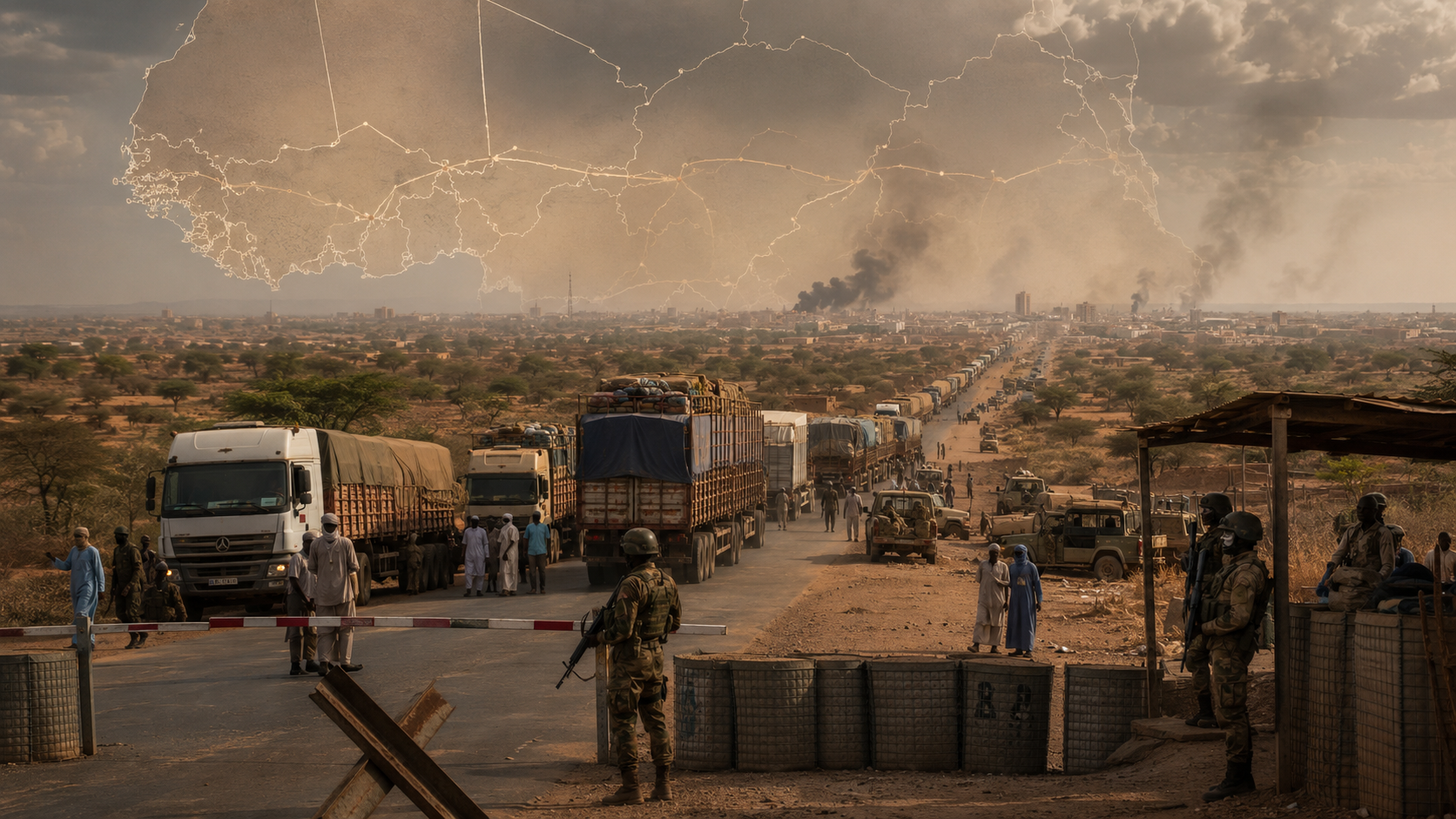
The operating environment is increasingly characterized by route insecurity, supply disruptions, localized shortages, and rising uncertainty over movement, staffing, and continuity. Corridor warfare and blockade tactics carry strategic weight because they affect urban provisioning, military mobility, investor confidence, and the state's ability to project normality.
A Mali presence can no longer be assessed by looking only at Bamako or national political headlines. Corridor risk, local access conditions, and the divergence between capital functionality and provincial deterioration now sit at the center of the operating picture.
The Wider Sahel System
Regional Security Architecture
The Mali crisis can't be read apart from the wider Sahel crisis linking Burkina Faso, Niger, and the coastal frontier. The region remains under pressure from expanding violent extremist operations, state weakness, military rule in key states, and an increasingly fragmented regional security architecture.
The Alliance of Sahel States has built a political framework for solidarity among Mali, Burkina Faso, and Niger. That framework hasn't yet produced the integrated operational effectiveness required to reverse insurgent momentum. The gap between political alignment and operational effectiveness stands as one of the central structural weaknesses in the present Sahel order.
Coastal Spillover Exposure
Instability is no longer contained to the classic Sahel belt. Mali's deterioration is increasingly linked to growing pressure on Gulf of Guinea frontier states, with prolonged insurgent adaptation in the Sahel likely to deepen cross-border violence, illicit flows, and governance strain further south.
This doesn't point toward imminent state failure in coastal West Africa. It does mean Mali's trajectory feeds a wider regional stress pattern in which weak local governance, rural insecurity, and anti-state armed mobility grow harder to contain at national borders.
External Positioning
Western View of Mali
Western assessments increasingly frame Mali as a strategic warning rather than a recoverable near-term success story. The April 2026 attacks removed remaining ambiguity about Mali's trajectory. Military-led approaches, whether backed by the West or by Russia, have failed to produce durable stabilization.
This framing marks a conceptual shift. Earlier Western positioning treated Mali as a troubled but salvageable partner for externally supported stabilization. The emerging position holds that without a credible return to democratic governance, effective civilian oversight, and measurable accountability, additional military support alone is unlikely to change the strategic trajectory.
Western View of Africa
Western views of Africa run more mixed than views of Mali specifically. Recent elections in Senegal, Botswana, Ghana, and Malawi stand as evidence that democratic competition and peaceful transfer of power remain viable on the continent. Democratic stress, inequality, state fragility, and youth disillusionment have made Western analysts more cautious about assuming linear democratic progress elsewhere.
Mali isn't treated as the definition of Africa. It's treated as a high-importance test case inside a broader continental debate. The operative question has shifted. It's no longer a question of whether democracy is possible in Africa. It's about whether democratic institutions can remain legitimate and effective when governments fail to deliver security, justice, and basic welfare under severe stress.
Mali as a Democratic Leading Indicator
Mali mattered historically because it appeared to show that a democratic transition in West Africa could survive major structural constraints. Its 1992 transition catalyzed wider political change across the region, and its success carried disproportionate weight for the future of democracy in West Africa.
That leading-indicator role hasn't disappeared. It has inverted. Mali now signals how quickly democratic legitimacy can erode when insecurity, elite failure, external security dependency, and poor state performance converge.
Mali no longer functions as a democratic anchor for the region. It serves as a warning that where governance repeatedly fails, the public turns away from democratic norms, not out of a preference for authoritarianism, but because institutions no longer appear capable of protecting life, property, dignity, or economic survival.
Risk Signal Grid
The grid below applies Ridgeline's three-tier signal architecture. Watch marks a factor that warrants monitoring without a near-term operational threshold breach. Warning marks a factor on a sustained negative trajectory with a credible path to operational impact inside the assessment window. Alert marks a factor that has crossed a threshold with near-term operational consequences.
| Risk Domain | Signal Tier | Trajectory | Trigger Type | Assessment |
|---|---|---|---|---|
| Regime and capital-core security | Alert | Worsening | Convergence | Coordinated attacks and capital-adjacent pressure raise the risk of leadership shock, airport disruption, curfews, and evacuation triggers. |
| Territorial control and provincial access | Alert | Worsening | Trajectory | Fragmented control creates movement restrictions, uncertain partner reliability, and a risk of town-level rupture beyond formal state claims. |
| Corridor and logistics continuity | Alert | Worsening | Sustained | Route interdiction and blockade tactics simultaneously threaten fuel, food, humanitarian access, and business continuity. |
| Humanitarian and civilian-protection exposure | Alert | Worsening | Sustained | Dual exposure to insurgent violence and abusive counterterrorism expands displacement, reputational risk, and legal exposure. |
| Democratic legitimacy and governance integrity | Alert | Worsening | Trajectory | Democratic rollback reduces institutional credibility, weakens oversight, and narrows the path to durable stabilization. |
| Regional spillover into neighboring states | Warning to Alert | Worsening | Convergence | Mali’s deterioration raises pressure on Niger, Burkina Faso, and coastal frontier states, amplifying wider West African instability. |
| Western-partner policy volatility | Warning | Mixed | Reversal | External engagement is growing more conditional and strategically fragmented, complicating long-term planning and support assumptions. |
Scenario Analysis
Scenario 1: Managed Deterioration
This is the most likely near-term scenario. The Malian state retains the capital and core institutional machinery. Insurgents continue to expand their coercive influence, pressure routes, and force localized withdrawals or negotiated accommodations in contested areas.
The country doesn't collapse outright, but the gap between nominal sovereignty and effective control widens. For organizations and governments, this outcome poses greater risk than a clean break because it produces chronic volatility, intermittent access, uncertain partner reliability, and recurring crisis surges.
Confidence: Moderate.
Scenario 2: Regime-Shock Escalation
This scenario is plausible but unlikely over the next three to six months. It would involve a major capital-core security incident, sustained blockade effects on Bamako, leadership disruption, or simultaneous territorial and corridor shocks severe enough to trigger an acute national crisis.
This scenario would accelerate external diplomatic activity, internal repression, and emergency security concentration around regime sites. It would substantially raise evacuation, continuity, and partner-integrity risk.
Confidence: Low to moderate.
Scenario 3: Partial Tactical Stabilization Without Strategic Recovery
This scenario carries roughly even odds as a subnational outcome and unlikely odds as a national solution. Concentrated military operations, localized deals, and tighter regime protection reduce visible attack tempo in selected areas without restoring long-term governance legitimacy or broad territorial control.
This outcome would likely be presented politically as a form of stabilization. It amounts to a tactical pause, not a strategic resolution. Surface calm in Bamako or a few major towns can coexist with worsening route insecurity, abusive local conditions, and growing insurgent embeddedness elsewhere. That combination creates false-reassurance risk for decision-makers who read capital-level calm as a national signal.
Confidence: Moderate as a subnational outcome, lower as a national solution.
Scenario 4: Democratic Re-Legitimation and Broader Stabilization
This is the least likely near-term scenario and the most constructive long-run path. It would require a credible time-bound transition process, restored political pluralism, improved civilian oversight, more accountable security practices, and a whole-of-government approach to local legitimacy and service delivery.
This scenario is unlikely in the near term because the current trajectory points in the opposite direction. It remains analytically important. No durable stabilization model is likely to succeed in Mali without some form of restored democratic legitimacy and institutional accountability.
Confidence: Low in the near term, higher as a necessary long-term condition.
Alternative Explanations and Analytic Caveats
One alternative interpretation holds that current reporting overstates insurgent strategic gains because dramatic attacks draw more attention than quieter areas where the state still functions. This interpretation is plausible and stays in view, particularly given data limitations and restricted access.
A second alternative holds that the Alliance of Sahel States framework generates stronger-than-expected coordination and learning effects, producing better medium-term outcomes than current evidence suggests. That possibility can't get ruled out, but current reporting still emphasizes security fragmentation, constrained operational capacity, and continued insurgent adaptation.
A third caveat: Mali's democratic decline shouldn't be mechanically generalized across Africa. The continent's political trajectories stay diverse, and positive democratic cases continue to exist. The narrower and stronger claim holds. Mali is a sentinel case for how democracy deteriorates under severe legitimacy and security stress. It isn't proof that the decline of continental democracy is inevitable.
Decision Implications
Strategic Implications
Mali should be treated as a compound-risk environment, not a single-category terrorism problem. The most consequential shifts now stem from the interplay among security deterioration, democratic erosion, humanitarian stress, and external-partner realignment.
The wider Sahel should be assessed as an interdependent risk system in which Mali acts as the leading node. Decisions on Niger, Burkina Faso, coastal West Africa, and broader African governance programming should account for how Mali's trajectory is shaping regional confidence in democratic and security models.
Monitoring Framework and Triggers
High-value indicators include capital-core incidents, corridor interdiction duration, northern town-control reversals, visible external force consolidation around regime sites, local accommodation with insurgents, humanitarian access denial, and any credible political roadmap. Each carries a distinct trigger type. Point-in-time applies to discrete incidents. Sustained applies to persistent conditions, such as corridor denial. Convergence applies where multiple indicators move together.
Indicators that would weaken the current judgment of deterioration include measurable, sustained reductions in attacks, restored route functionality, improved humanitarian access, and credible democratic transition benchmarks backed by enforcement mechanisms. A reversal trigger on any of these warrants immediate reassessment of the base case.
Decision Recommendations
Annex A: Portfolio Governance
- Treat Mali as an integrated risk portfolio, not a country-desk silo. Review security, supply chain, compliance, humanitarian, and reputational variables in a single decision forum, as they now interact directly.
- Adopt corridor-based operating assumptions. Country-level green, yellow, and red labels fall short, as Bamako remains partially functional while provincial routes and adjacent nodes deteriorate materially.
- Use leading indicators for escalation. Trigger governance review and continuity planning on coordinated attack patterns, route denial, or capital-core stress rather than waiting for formal state collapse.
- Stress-test partner integrity. Counterpart risk now includes human-rights exposure, command reliability, and localized coercive arrangements with armed actors.
- Separate regime continuity from national stability. A secure presidential core doesn't imply stable operating conditions across Mali.
Annex B: Tradecraft Discipline
- State key judgments explicitly. Avoid indicators or briefs that describe events without clarifying how they change assessed likelihoods.
- Differentiate evidence from inference. A reported withdrawal is evidence. A conclusion that the regime is losing strategic control is an analytic judgment and must be stated as such.
- Attach confidence levels to every major judgment. This carries added weight in Mali, where access constraints and information operations distort the reporting picture.
- Track disconfirming evidence. A serious, sustained reduction in attack tempo or an improvement in local service delivery counts as meaningful contrary evidence, not tactical noise.
- Use indicators that would alter judgments. Capital-core incident flags, corridor disruption indexes, northern rupture flags, and democratic-transition indicators should each carry a clear reassessment trigger.
Annex C: Executive Watchlist, Next 90 Days
- Additional coordinated multi-region attack waves involving JNIM and allied or parallel actors.
- Sustained Bamako supply-route disruption or fuel and food continuity stress.
- Confirmed withdrawals or loss of control in strategic northern towns.
- More visible evidence that external security support concentrates on regime preservation rather than territorial recovery.
- Any credible, time-bound political roadmap restoring pluralism, electoral sequencing, and civilian oversight.
- Signs of spillover deterioration in neighboring and coastal frontier states sufficient to change regional operating assumptions.
Closing Assessment
Mali now stands as one of the clearest warning cases in Africa of what happens when democratic legitimacy, governance effectiveness, and security provision fail simultaneously. The core conclusion runs past the observation that Mali is unstable. Mali's instability has turned regionally generative. It shapes how the Sahel evolves, how external powers frame Africa policy, and how observers assess the resilience of democracy under extreme stress in West Africa.
The democratic lesson runs more severe than the security lesson alone. Mali once indicated that democratic consolidation in West Africa could endure despite structural adversity. Today it indicates the opposite: where governance and legitimacy collapse go unreversed, military responses and external partnerships alone are unlikely to produce durable order.