
BOLIVIA FLASHPOINT ANALYSIS
A 360° Geopolitical and Geoeconomic Assessment
Executive Intelligence Summary
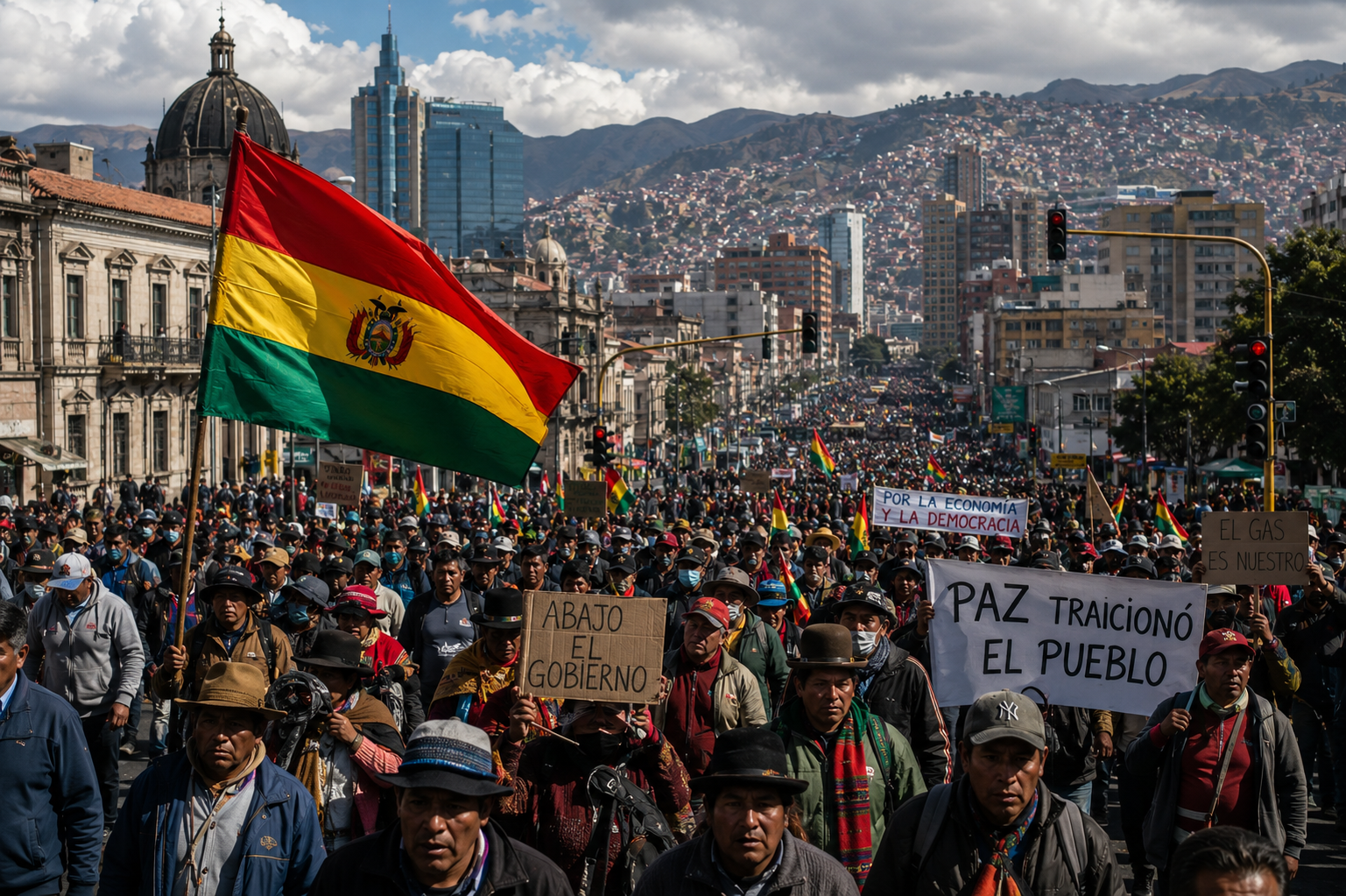
Bolivia is experiencing its most severe simultaneous convergence of political, economic, and social crises in four decades. As of late May 2026, La Paz has been effectively besieged. A coalition of labor unions, Indigenous organizations, miners, teachers, and supporters of former President Evo Morales has surrounded the capital, demanding the resignation of President Rodrigo Paz, who entered office just six months ago in November 2025.
Approximately 67 roadblocks span the national territory. Bolivia's interior trade and transport infrastructure has been paralyzed. Food and fuel shortages are confirmed. Hospital oxygen supplies have been cut. Deaths have occurred, including patients who couldn't reach medical facilities through blocked roads. Business organizations report economic losses exceeding $50 million per day, with approximately 5,000 vehicles stranded on national highways.
The crisis didn't materialize suddenly. It's the visible surface fracture of a deep structural fault line built over the years. Three forces converged: the exhaustion of Bolivia's commodity-boom economic model, the implosion of the Movement for Socialism political coalition, and the emergence of a new center-right government with a strong reform mandate but fragile institutional foundations.
President Paz inherited what he's publicly described as a "bankrupt state." International reserves are effectively depleted. The fiscal deficit is 9-10% of GDP despite partial consolidation efforts. Inflation peaked at 20.4% in 2025 and remains at 14.18% annually as of April 2026. External debt is approximately 95% of GDP, with $1.6 billion in payments due in the current calendar year alone.
The geopolitical dimension reaches well beyond Bolivia's borders. The United States, having restored ambassadorial relations in November 2025 after a seventeen-year rupture, has explicitly framed the protests as a coup attempt and publicly backs the Paz government through senior-level statements. A diplomatic rupture with Colombia erupted simultaneously after President Gustavo Petro characterized the protests as a legitimate popular insurrection, triggering mutual ambassador expulsions.
Bolivia's strategic importance as the holder of the world's largest lithium reserves, estimated at 23 to 24 million metric tons beneath the Uyuni salt flat, means the contest over Bolivia's political orientation is simultaneously a contest over global battery-supply-chain positioning. Against the backdrop of the Strait of Hormuz energy shock beginning February 28, 2026, which has driven global fuel prices dramatically higher and compounded Bolivia's domestic fuel crisis, the convergence of factors creates an exceptionally complex risk environment.
| DSS RISK RATINGHIGH | TRAJECTORYDETERIORATING | TIME HORIZON6–18 MONTHS |
|---|
II. Country Profile and Strategic Context
II-A. Geography, Demographics, and Political Economy Baseline
Bolivia is a landlocked, plurinational state of approximately 11.4 million people at the center of South America. It shares borders with Brazil to the north and east, Argentina and Paraguay to the south, and Chile and Peru to the west. Its landlocked status isn't a peripheral geographic detail. It's a defining constraint on Bolivia's economic strategy, diplomatic relations, and crisis-management capacity. All Bolivian imports and exports must traverse neighboring states. Bolivia depends entirely on port access agreements with Chile and Peru.
The country's demographic and political geography is equally consequential. Approximately 40% of Bolivia's population identifies as Indigenous, the highest proportion in the Western Hemisphere. The largest concentrations sit in the western highland departments of La Paz, Oruro, and Potosí. La Paz and El Alto, a predominantly working-class and Indigenous city of over one million people on the altiplano plateau immediately above the capital, together form the gravitational center of Bolivian politics.
Since the Water Wars of 2000 and the Gas War of 2003, El Alto has functioned as the decisive pressure point in national political mobilizations. When El Alto blockades the road from the altiplano down to La Paz, it places the capital under siege in both physical and political terms. That is precisely what's occurring today.
Bolivia's economic structure over the past two decades has rested on the extraction and export of natural gas, primarily to Argentina and Brazil, under long-term supply contracts managed by the state hydrocarbon company YPFB. At its peak in 2014, natural gas exports generated approximately $6 billion annually. That model began its structural unraveling around 2016 as production from mature fields declined without major new investment in exploration. By 2024, Bolivia had effectively transformed from a net energy exporter to a net energy importer. That reversal is both geopolitically and fiscally devastating, and it directly precipitated the current crisis.
II-B. The MAS Era in Retrospect: Legacies and Liabilities
Understanding the depth of the current crisis requires a clear accounting of the long-term structural impacts of the MAS political economy. These function as inherited liabilities for the Paz government and as enduring ideological resources for the opposition.
The Movement for Socialism under Evo Morales and his handpicked successor, Luis Arce, achieved measurable gains in poverty reduction, social mobility, and Indigenous political representation that remain embedded in Bolivian political culture. During the peak commodity years, Bolivia's GDP per capita tripled. Poverty rates fell from over 60% to under 35%. The country achieved high single-digit annual growth rates. These achievements created a deep political and cultural bond between the MAS and Bolivia's Indigenous and working-class communities.
The structural liabilities are no less consequential. The government maintained fuel subsidies that cost approximately $2 billion per year, even as fiscal revenues declined, financing the shortfall through central bank monetary expansion and the liquidation of foreign reserves. YPFB received no meaningful capital reinvestment for upstream gas exploration. The central bank extended non-performing loans to state enterprises and used opaque gold transactions to maintain the appearance of reserve adequacy. By the time the Arce government ended in 2025, Bolivia's central bank was likely insolvent by independent assessment. The boliviano was assessed to be approximately 38% overvalued relative to economic fundamentals.
The MAS era also produced the political fragmentation that made Paz's 2025 election possible and simultaneously created the structural weaknesses that make his governance precarious. When Morales and Arce became antagonists, the MAS split into two factions, dividing the left-wing vote. Paz won the presidency with a plurality on a center-right Christian Democratic Party platform. His victory reflected the mathematical division of his opposition rather than a mandate from the majority. A majority of the Bolivian electorate remains ideologically aligned with some variant of the MAS political tradition. That political arithmetic defines the space available to the Paz government for economic reform.
III. The Anatomy of the Current Crisis
III-A. The Trigger Sequence: From Decree 5503 to National Siege
The current crisis is best understood not as a single event but as a sequence of compounding triggers that have progressively broadened the opposition coalition and intensified the unrest. Ridgeline identifies five distinct phases in this escalation arc.
Phase One: Economic Emergency Declaration (December 2025)
Upon taking office, President Paz declared a national economic, financial, energy, and social emergency. Paz's stabilization strategy rested on three pillars: fiscal consolidation, exchange-rate flexibility, and a new growth agenda centered on private investment in hydrocarbons, mining, and eventually lithium. To operationalize fiscal consolidation, Paz promulgated Supreme Decree 5503, which simultaneously eliminated fuel subsidies (driving gasoline prices up 86% and diesel prices up 162%), privatized aspects of natural resource management, fast-tracked foreign extractive concessions, and introduced sweeping changes to central bank governance. One hundred and twenty-one articles of market liberalization were packaged into a single emergency decree.
Phase Two: January 2026 Mobilization and Partial Retreat
The COB, Bolivia's national labor federation, organized a nationwide wave of protests in January 2026. Faced with this mobilization, Paz abrogated Decree 5503 and replaced it with a narrower decree that maintained the removal of fuel subsidies while dropping the broader privatization agenda. This partial concession established a damaging precedent. It demonstrated that sustained social pressure could force a presidential retreat and incentivize future mobilization, while retaining the fuel subsidy removal maintained the underlying economic grievance for approximately 12 million Bolivians, who were confronting dramatically higher living costs.
Phase Three: Agrarian Law Trigger and COB Strike (May 2026)
A new legislative trigger detonated the current crisis. The Paz government advanced a law permitting landowners to use agricultural land as collateral for mortgages, widely perceived by Indigenous and small-farming communities as a mechanism for large agribusiness interests to accumulate land at the expense of smallholders. The COB issued an open-ended general strike beginning May 5, 2026, joined by Indigenous organizations, transport workers, miners, teachers, and healthcare staff. This was the broadest coalition assembled against the Paz government.
Phase Four: Paz Annuls the Law; Protests Expand (May 13-19)
In a pattern echoing the January capitulation, Paz annulled the agrarian law on May 13, 2026. But protests expanded rather than subsiding. This is the analytically crucial phase of the current crisis. The movement has decoupled from specific policy grievances and metastasized into a broader anti-government, anti-austerity, and increasingly anti-system mobilization. Demands have grown diffuse, including calls for structural economic relief, for Paz's resignation, and for an end to judicial proceedings against Evo Morales. By May 18, approximately 180 demonstration events had been recorded in May alone, on a trajectory to surpass January's peak.
Phase Five: Regional Escalation and International Response (May 20-present)
As of publication, the crisis has assumed overt regional dimensions. Eight allied Latin American nations issued a collective statement denouncing actions aimed at undermining democratic stability. Colombia expelled Bolivia's ambassador and was itself expelled. Argentina dispatched military Hercules aircraft on a humanitarian airlift mission to supply La Paz. The US State Department issued explicit condemnations framing the protests as an attempted coup backed by organized crime. Morales announced his intention to lead a 190-kilometer march to La Paz to demand presidential resignation. Total confirmed deaths have reached at least four as of May 21, with figures as high as 24 total fatalities reported through other channels.
III-B. The Morales Variable: A Specific Trip-Wire Analysis
A DSS analysis of Bolivia's crisis can't be complete without a specific assessment of Evo Morales as an independent risk variable. Not simply as a historical figure, but as an active force shaping the dynamics of the current crisis.
Morales served as Bolivia's first Indigenous president from 2006 to 2019, when he resigned under military pressure following a disputed election. His relationship with Luis Arce deteriorated into open antagonism as Morales sought to reclaim the presidency. In June 2024, a failed coup attempt by military commander Juan José Zúñiga illustrated the degree to which Bolivian politics had become a labyrinthine conflict among former allies.
The critical current DSS trigger centers on an arrest warrant reissued against Morales on May 12, 2026, after he failed to appear in court for trial on human trafficking charges. Morales has denied all wrongdoing and frames the legal proceedings as political persecution. He remains in his base of operations in the Chapare region of Cochabamba, Bolivia's primary coca-growing zone, where his supporters have vowed to prevent his arrest by force.
| BINARY TRIGGER SCENARIOIf Paz attempts to execute the arrest warrant, coca growers and Morales loyalists in Chapare would likely mount paramilitary-level resistance, potentially opening a second military confrontation in Cochabamba while La Paz remains under siege. If Paz declines to execute the warrant, the rule of law is further eroded, Morales is emboldened to continue his role in mobilization, and the judicial process is subordinated to political expediency. Neither path is without severe institutional damage. |
|---|
The connection between the Morales camp and Bolivia's drug trafficking networks is analytically non-trivial. The Chapare is not only Morales's political base but the heartland of Bolivia's coca production and cocaine processing expansion. Any scenario in which the Morales factor remains unresolved leaves a significant narco-linked destabilization force with operational capacity adjacent to the government's main crisis theater.
III-C. The Paz Government's Internal Fractures
The crisis is further complicated by documented tensions within the governing coalition itself. President Paz and Vice President Edmand Lara exhibited deep fissures within weeks of taking office. By December 2025, Lara had publicly criticized the Paz administration on social media, calling Paz a liar and accusing him of surrounding himself with corrupt ministers, while demanding the dismissal of the Minister of Government. The Ministry of Justice was closed, and Lara's only cabinet appointee was dismissed, opening a formal political rift.
A vice-presidential defection, even partial, would dramatically alter Bolivia's political calculus. Lara controls the vice presidency and legislative presidency simultaneously under Bolivia's constitutional structure. Any scenario in which Lara publicly withdraws support from Paz, backs a congressional censure, or supports an early election call would materially accelerate the probability of a forced resignation.
IV. Economic Anatomy: A Structural Failure in Five Dimensions
IV-A. The Balance of Payments Crisis
Bolivia's economic crisis is best characterized as a balance-of-payments crisis compounded by fiscal and energy-sector crises. Three mutually reinforcing failures share common roots in the exhaustion of the commodity-boom model. The most rigorous independent assessment concludes that Bolivia's central bank is likely insolvent and that the boliviano requires a formal devaluation of approximately 32.5% to restore current account sustainability and rebuild reserve adequacy.
The reserve situation is the most acute near-term vulnerability. Bolivia's liquid international reserves have fallen to levels covering less than one month of imports. The boliviano has maintained a fixed exchange rate of 6.96 per US dollar. This peg was defensible when gas export revenues were substantial, but it is now dramatically inconsistent with economic fundamentals, with the currency assessed at approximately 38% overvalued. The parallel exchange rate market commands a substantial premium over the official rate, reflecting the structural misalignment.
The devaluation question is the central sticking point in Bolivia's negotiations with the IMF. The IMF's standard approach for a country in Bolivia's position would require devaluation as a prior condition for program disbursement. The Paz government has, to date, been unwilling to execute a formal devaluation. Bolivia successfully issued $1 billion in dollar-denominated bonds on May 7, 2026, at 9.75% for five-year notes. That provided a temporary liquidity injection, but it's not a substitute for structural adjustment.
IV-B. The Fiscal Deficit and Debt Sustainability
Bolivia's fiscal position has deteriorated steadily since 2016, reaching a deficit of approximately 10% of GDP in 2024 before partial consolidation efforts brought it to approximately 9%. Total external debt stands at approximately 95% of GDP, with $1.6 billion in scheduled payments due in 2026 and total obligations of approximately $12 billion through 2030. Independent debt sustainability analyses assess this repayment timeline as incompatible with Bolivia's projected capacity to generate dollar earnings. A five-year external debt reprofiling is considered essential to buy time for structural reforms to generate fiscal recovery.
The Paz government's fiscal record through the first six months is instructive in its ambiguity. Paz has communicated the right structural diagnosis and correctly identified the necessary solutions. Execution, however, has lagged dramatically. The partial elimination of fuel subsidies was the most significant reform implemented, and it triggered the very crisis now threatening the reform program's survival. The combination of some reform, some capitulation, and inconsistent sequencing has simultaneously reduced Paz's credibility with both multilateral lenders and domestic social constituencies.
IV-C. The Energy Sector Collapse
Bolivia's energy sector status represents perhaps the most consequential structural reversal in the country's modern economic history. From 2005 to approximately 2016, Bolivia was a major natural gas exporter to Argentina and Brazil. The deliberate underinvestment in YPFB's upstream exploration and development capacity, as MAS governments extracted dividends from the sector rather than reinvesting in reserve replacement, led to a catastrophic depletion of output from producing fields without new field development. By 2024, Bolivia was importing refined petroleum products. A complete structural inversion from its former exporter status.
The domestic fuel situation has been further aggravated by the global energy shock caused by the closure of the Strait of Hormuz beginning February 28, 2026. For Bolivia, already dependent on fuel imports, this external shock translated directly into higher import costs at precisely the moment when the government was attempting to eliminate fuel subsidies and was running out of foreign exchange to fund imports. Bolivia currently faces a fuel import gap of approximately $300 million against an estimated $63 million per week required to normalize domestic fuel supply.
IV-D. The Lithium Paradox: Structural Asset, Near-Term Liability
Bolivia holds an estimated 23-24 million metric tons of lithium resources beneath the Uyuni salt flat in Potosí Department. This deposit is the largest identified lithium deposit on Earth, according to most independent assessments. It's been the subject of extraordinary international attention as projections of global battery demand for the energy transition have elevated the lithium supply chain to a primary geostrategic priority for the United States, Europe, China, and major automotive manufacturers. Bolivia's lithium is, in theory, a transformative national asset.
In practice, Bolivia's lithium remains economically stranded for reasons that won't be resolved by political change alone. The chemical profile of Bolivian brine is technically challenging. The high magnesium-to-lithium ratio in the Uyuni salar requires more complex and expensive processing than competing deposits in Chile's Atacama or Argentina's lithium provinces. Bolivia exported approximately $19 million worth of lithium products in 2025. That number is trivially small relative to the scale of the resource base.
The pending investment agreements, approximately $2 billion from Chinese firms CATL/BRUNP and CMOC and Russia's Uranium One Group, are stalled in contractual review, legislative opposition, and the Paz government's assessment of their terms. The current instability makes any near-term binding investment commitments from any source highly unlikely.
| RIDGELINE STANDING GUIDANCEBolivia is not a viable near-term lithium supply source. Investment in Chilean Atacama and Argentine Jujuy/Salta projects remains the operationally superior position. Bolivia’s lithium should be treated as a medium-to-long-term optionality. Valuable once political and economic stabilization is achieved. Carrying unacceptable near-term development risk under current conditions. |
|---|
IV-E. Macroeconomic Indicator Dashboard
| Indicator | Value | Comparative Context |
|---|---|---|
| GDP Growth (2024) | -1.58% | Regional average ~1.5% growth |
| GDP Growth Forecast (2026) | -3.3% | Accelerating contraction |
| Annual Inflation — 2025 peak | 20.4% | Highest since the hyperinflation era |
| Annual Inflation — April 2026 | 14.18% | Remained elevated post-subsidy removal |
| Fiscal Deficit (% of GDP) | ~9% | Target was 7%; sustainability threshold ~3% |
| External Debt / GDP | ~95% | Approaching distress threshold |
| Debt Payments Due 2026 | $1.6 billion | Unsustainable without an IMF bridge |
| Liquid International Reserves | <1 month imports | Below the IMF minimum adequacy threshold |
| Boliviano Overvaluation | ~38% | Estimated; devaluation politically blocked |
| Daily Protest Economic Cost | >$50 million | Business group estimates |
| 2026 Bond Issuance | $1B at 9.75% (5yr) | First market access since 2022 |
| Lithium Exports (2025) | ~$19 million | Trivial relative to reserve potential |
V. Geopolitical Landscape: The 360° View
V-A. The United States: Strategic Opportunity and Active Engagement
The United States government, under the Trump administration, views Bolivia's political transition under Paz as one of the most significant strategic realignments in the Western Hemisphere in a generation. For seventeen years, the US maintained only chargé d'affaires-level representation in Bolivia following the mutual expulsion of ambassadors under Morales in 2008. The November 2025 ambassador restoration, the February 2026 resumption of DEA counternarcotics cooperation, and Secretary Rubio's characterization of Paz's election as a transformative opportunity all reflect a high-priority re-engagement that places Bolivia at the center of the administration's Latin America strategy.
The US support for Paz is both a stabilizing factor and a political liability. It provides Paz with diplomatic cover, multilateral financial facilitation, and intelligence and security cooperation. Simultaneously, it provides the opposition with a powerful narrative: that Paz governs at the direction of Washington in service of US strategic interests rather than Bolivian popular will. This narrative resonates deeply in a country with a complex history of US interventionism.
V-B. China: Economic Leverage and Structural Exposure
China's engagement with Bolivia under the MAS era was extensive and strategic. China became Bolivia's largest single trading partner in 2024, surpassing Brazil. Bolivia joined China's Belt and Road Initiative in 2018 and was accepted as a BRICS partner nation in January 2025, formalizing its alignment with China's alternative multilateral institutional architecture at the very moment the MAS government was entering its terminal phase.
China's near-term interests in Bolivia center on two primary assets: the pending lithium investment contracts and the broader trade relationship. Beijing's approach in Latin America is notably pragmatic rather than ideologically rigid. China has maintained robust economic relationships with center-right governments across the region, even as political orientations have shifted. The Paz government's review of Chinese lithium contracts creates tension, but China is likely to manage this through sustained commercial engagement rather than adversarial posture.
V-C. Russia: Targeted Exposure with Limited Leverage
Russia's footprint in Bolivia is more targeted and transactional than China's. Uranium One Group has signed agreements to participate in lithium production in Bolivia, with Russian state entities representing Bolivia's primary lithium export destination in both 2023 and 2024. Under Paz, these relationships are under review, and the foreign policy pivot toward the US explicitly includes distancing from Russia's bloc of aligned states.
Russia has limited economic leverage in Bolivia relative to China. Russian influence in Bolivia is exercised primarily through ideological alignment with Morales-legacy networks and through the Bolivia-Russia lithium relationship. This creates a modest but real incentive misalignment: Russia benefits from Paz's weakness, while China can afford to wait for political normalization.
V-D. Regional Dynamics: The Andean Political Realignment
Bolivia's crisis must be situated within the broader Andean and Latin American regional political cycle of 2024 to 2026. A succession of center-right electoral victories created what analysts describe as a pro-US bloc spanning the western portion of South America. This bloc is inherently fragile. Each member government faces domestic social resistance to austerity-aligned economic reform in societies where the state-led developmentalist model retains deep cultural roots.
The Colombia-Bolivia diplomatic rupture is the most acute manifestation of the current regional ideological fracture. Colombian President Gustavo Petro's characterization of Bolivia's protests as a popular insurrection and his expressions of solidarity with Morales reflect a pattern in which leftist governments explicitly use each other's domestic crises as foreign policy leverage. The episode reduces the probability of coordinated regional crisis mediation, as the major regional left-wing and center-right governments are now on opposite sides of the analytical divide.
VI. The Strait of Hormuz Compounding Factor
A comprehensive assessment of Bolivia's crisis must explicitly account for the closure of the Strait of Hormuz as a material compounding factor. Not a background context item, but a direct determinant of Bolivia's near-term crisis trajectory.
The effective closure of the Strait of Hormuz to commercial shipping beginning February 28, 2026, created the largest global energy supply disruption since the 1973 Arab oil embargo. Approximately 20 million barrels per day of crude oil transit, representing roughly one-fifth of global oil consumption, was disrupted. Brent crude prices surged from approximately $73 per barrel before the conflict to over $100 per barrel in March, with the physical crude premium reaching nearly $140 at peak levels.
For Bolivia, this external energy shock produced three direct impacts. First, it dramatically increased the cost of fuel imports precisely when the government was attempting to eliminate domestic subsidies. Second, it provided the opposition with a politically powerful narrative linking domestic fuel shortages to a globally discrediting backdrop. Third, it complicated Bolivia's IMF negotiations by making the macroeconomic forecasts underlying a program agreement less stable. An oil shock of this magnitude introduces variance into inflation trajectories, current account projections, and fiscal consolidation timelines that multilateral lenders must account for in program design.
VII. Second-Order Effects Analysis
VII-A. Trade and Supply Chain Disruption: Regional Dimensions
Bolivia's geographic centrality in South American land-based trade networks means that the current protest blockade regime is not merely a domestic political crisis. It's a regional supply chain disruption event affecting five neighboring economies simultaneously. When the La Paz-Oruro-Potosí corridor and the approaches to the Chilean border crossings are simultaneously blockaded, freight movements across the entire central South American corridor are degraded.
For freight operators, the operational reality is approximately 7 to 21 days of added transit uncertainty on Bolivia-transiting corridors under current blockade conditions, with no reliable normalization timeline. The humanitarian dimension has already produced measurable emergency-level impacts. Bolivia's Catholic bishops' conference issued an emergency appeal on May 17, characterizing the blockade situation as a humanitarian crisis, citing the deaths of multiple patients unable to reach hospitals. Argentina's deployment of military Hercules transports on a humanitarian airlift to La Paz reflects an assessment that the ground corridor is genuinely non-functional for essential supply movement.
VII-B. Financial Market Implications: Sovereign Debt and Credit
Bolivia's sovereign bonds carry junk-level ratings from both Fitch and Moody's. The successful issuance of $1 billion in dollar-denominated bonds on May 7, 2026, at 9.75% represented a genuine early financing win for the Paz government, but the issuance occurred days before the most severe escalation of protest violence in mid-to-late May. Markets will now reassess the credit story against a materially worse operational environment than existed at issuance.
The mathematics of debt sustainability are unambiguous regardless of the political outcome. Bolivia requires a five-year external debt reprofiling to create the fiscal runway needed for reforms to materialize. The key financing-pathway variables are whether the IMF program can be agreed upon and at what level of conditionality, whether the boliviano devaluation prior action can be accepted by the government, and whether bilateral creditors can be brought into a coordinated reprofiling framework alongside private creditors.
VII-C. Narcotics Trafficking Escalation: A Regional Security Dimension
Bolivia occupies a structurally critical position in South American narcotics networks. Bolivia is the world's third-largest coca leaf producer and functions as a key processing and transit hub for cocaine flows moving from Andean production zones to Brazilian, Argentine, Chilean, and European distribution networks. Data confirms a 74% increase in drug-processing sites detected in Bolivia from 2023 to 2024. Annual cocaine seizures increased 115% from 2023 to 2024, indicating both improved interdiction and substantially higher trafficking volume.
The DEA counternarcotics cooperation resumed in February 2026, requiring institutional stability to function. Anti-narcotics police units operating in the Chapare have already been ambushed during the current crisis period. If the political crisis produces a government too weakened to maintain rural enforcement presence, the Chapare becomes effectively ungoverned from a narcotics control standpoint. A development that would have immediate consequences for drug flow volumes into neighboring Brazil, Argentina, and Chile.
VII-D. Humanitarian and Governance Deterioration
The humanitarian signals from La Paz represent acute, near-term indicators of a governance capacity crisis that could cause long-term institutional damage if prolonged. Documented impacts as of publication include hospitals depleted of oxygen and medical supplies, confirmed deaths of patients unable to receive emergency care, food market disruptions causing visible shortages across the La Paz-El Alto metropolitan corridor of over 3 million people, suspension of public school classes across multiple departments, and approximately 5,000 commercial vehicles stranded with economic loss accumulating at over $50 million daily.
The proposed anti-blockade legislation, which would criminalize road blockades with prison sentences of up to 30 years, represents a policy response that would likely produce a constitutional challenge and amplify rather than suppress protest activity. Given that roadblocks are deeply embedded in Bolivian political culture as a constitutionally protected form of collective expression, such legislation would mobilize civil-liberties constituencies alongside economic-grievance constituencies.
VIII. Third-Order Effects: The Long Horizon
VIII-A. US Monroe Doctrine Credibility and the Andean Test Case
Bolivia's crisis has assumed the character of a test case for the Trump administration's reimagined Monroe Doctrine in Latin America. Bolivia under Paz represents the clearest case of a newly US-aligned government in a country that was, until recently, one of the region's most explicitly anti-US administrations.
If the Paz government is destabilized or forced to resign within its first year, the signal to other reform-oriented, US-aligned governments across the Andes would be deeply damaging. It would suggest that US political backing doesn't translate into sufficient economic support or security assistance to survive the social backlash from structural adjustment. Conversely, if Paz survives and achieves even partial stabilization, it strengthens the political viability of the pro-US reform bloc and provides a template for IMF-backed adjustment amid social opposition.
VIII-B. Lithium Triangle Implications and the Energy Transition Supply Chain
Bolivia's prolonged instability has strategic implications for the global energy transition that extend well beyond the immediate region. The lithium triangle, the concentration of high-quality brine in Bolivia, Chile, and Argentina, is increasingly recognized as the Saudi Arabia of the battery economy. Bolivia's portion of this triangle will remain inaccessible for commercial production at scale as long as the current instability persists and the technical challenges of processing high-magnesium brine are not addressed.
This is actually a manageable situation for global lithium supply chains in the near term. Chile and Argentina have sufficient production capacity expansion under development to cover projected demand growth through 2028 to 2030 without Bolivian contributions. The longer-term implication is more significant. If Bolivia's institutional dysfunction persists into the 2030s, it will have squandered its natural-resource inheritance during the critical window of the battery economy's buildout. A structural tragedy-of-the-commons scenario with parallels to the deterioration of Venezuela's petroleum sector.
VIII-C. Democratic Backslide and Institutional Contagion
Bolivia has the highest historical rate of coups and unconstitutional government changes of any country in the modern Western Hemisphere. This history creates a specific risk of normalization. Each repeated crisis that resolves through presidential resignation or military intervention reinforces the precedent that sustained social pressure is an effective substitute for the ballot box, perpetuating the cycle.
The current crisis is not only a test of Paz's political survival but also of whether Bolivia can sustain constitutional governance through an economically painful yet democratically legitimate reform program. A third consecutive administration that fails to complete its term would represent a qualitative degradation of Bolivia's democratic norms, from which recovery would become progressively harder.
VIII-D. Migration Pressure and Regional Social Strain
Bolivia has not historically generated migration outflows at the scale of Venezuela, Haiti, or Central America's Northern Triangle. However, the combination of a -3.3% GDP contraction forecast for 2026, 14% annual inflation, fuel and food shortages, and a governance crisis without a clear near-term resolution creates the structural conditions for elevated outward migration. Bolivia's most exposed immediate neighbors are Argentina and Chile. Both countries are managing their own economic pressures. A significant surge in Bolivian migration would strain social services and bilateral diplomatic relations at precisely the moment when those governments are attempting to project regional solidarity.
IX. Scenario Analysis and Probability Assessment
Ridgeline's scenario matrix identifies five distinct trajectory paths for Bolivia over the next 6 to 18 months. These probabilities reflect our current assessment as of late May 2026 and are subject to revision as the Morales variable, IMF program status, and protest trajectory evolve.
| Column 1 | Scenario | Prob. | Description |
|---|---|---|---|
| S1 | Managed Stabilization | 20% | Paz retains power. Cabinet reshuffle includes Indigenous representation. Protests gradually demobilize. The IMF program agreed with modified conditionality. Boliviano devaluation executed in a phased approach. Economic indicators begin improving by Q4 2026. |
| S2 | Prolonged Deadlock | 40% | Paz survives, but governing capacity is severely constrained. Reform agenda stalls. IMF program delayed or agreed with insufficient conditionality. The economy continues to contract. Protest activity cycles at elevated levels. Narco corridor deterioration accelerates. |
| S3 | Forced Resignation | 20% | Sustained escalation triggers irresistible pressure. Lara withdraws support. Paz resigns within 6 to 12 months. Constitutional succession or early elections. IMF negotiations suspended. US re-engagement significantly complicated. |
| S4 | Authoritarian Consolidation | 10% | State of emergency declared. The military deployed to clear blockades. Anti-blockade legislation was enacted. Short-term stabilization was purchased at the cost of democratic norms. Opposition radicalization accelerates in the medium term. |
| S5 | Disorderly Economic Collapse | 10% | IMF program failure, Hormuz shock persistence, and political crisis combine. Boliviano collapse. Sovereign default. Hyperinflationary episode. Maximum regional and global spillover. |
| RIDGELINE NOTES2 and S3 together account for 60% of the probability distribution. The most operationally important distinction is the Morales arrest variable. It represents the highest-probability path from S2 to S3, and its management will be the single most consequential decision the Paz government makes in the next 90 days. |
|---|
X. Decision Signal System Watch List
Ridgeline's DSS framework identifies the following specific indicators as the highest-priority monitoring triggers for Bolivia. These signals are organized by time horizon and operational urgency.
| Tier One — Immediate Triggers (24 to 72 Hour Horizon) | Column 2 |
|---|---|
| Morales Arrest Attempt in Chapare | Would trigger paramilitary-level mobilization by coca growers and likely open a second security front concurrent with La Paz blockades. Probability of escalation to S3 or S4 if this occurs: estimated 60%+. |
| State of Emergency Declaration | Indicates transition to S4 scenario. Expect sharp humanitarian escalation and international isolation dynamics. |
| Mass Casualty Security Incident | A single event with 10+ fatalities from a security force-protester confrontation would cross a threshold that has historically produced political tipping points in Bolivia. |
| Paz Resignation or Early Election Announcement | Triggers S3 scenario. Cascading impacts across IMF negotiations, bond markets, and regional political alignment. |
| Tier Two — Near-Term Structural Signals (2 to 8 Week Horizon) | Column 2 |
|---|---|
| IMF Program Term Sheet | Announcement of a draft program agreement would represent the single most stabilizing signal available. Absence of progress by the end of June 2026 increases S2 probability substantially. |
| Boliviano Devaluation Announcement | The critical prior action that unlocks IMF financing. A 20%+ devaluation would be a significant short-term shock with medium-term stabilizing effects. |
| Cabinet Reshuffle Composition | Whether it includes Indigenous, working-class, or COB-connected figures will determine whether the government can achieve a negotiated demobilization of any protest sectors. |
| ACLED Monthly Protest Event Count | The January 2026 peak of approximately 270 events is the reference threshold. If May 2026 or June 2026 events exceed this level, the escalation arc has not crested. |
| Colombia-Bolivia Diplomatic Status | A full severance of diplomatic relations or an OAS resolution would indicate the institutionalization of the regional crisis. |
| Morales March to La Paz | If Morales’s announced 190-kilometer march materializes and reaches La Paz, the likelihood of a leadership-convergence event with mass casualties increases substantially. |
| Tier Three — Medium-Term Strategic Signals (3 to 12 Month Horizon) | Column 2 |
|---|---|
| Boliviano Exchange Rate Sustainability | Whether the Paz government can implement a controlled devaluation without triggering hyperinflationary dynamics is the central macroeconomic test. |
| Lithium Contract Renegotiation Outcomes | The direction of resolved contracts will define Bolivia’s medium-term economic and geopolitical positioning. |
| Paz Government 12-Month Survival Benchmark | Reaching a full year in office by November 2026 would represent a significant signal of stabilization in a country where presidential continuity has historically been irregular. |
| Strait of Hormuz Resolution Timeline | If the Hormuz crisis extends beyond July to August 2026, Bolivia’s fuel import costs remain elevated, complicating fiscal consolidation and amplifying social pressure. |
| DEA Cooperation Continuity | Any disruption to DEA operational presence would signal governance deterioration in the counter-narcotics domain and would likely trigger US policy reassessment. |
| Debt Reprofiling Negotiations | Whether Bolivia can achieve a five-year coordinated bilateral and private debt reprofiling determines whether S5 remains a tail risk or becomes base-case by 2027 to 2028. |
XI. Sector-Specific Guidance for Ridgeline Clients
Global Supply Chain and Logistics Operations
Organizations with operations in or supply chains transiting Bolivia face three specific operational constraints under current conditions. First, road blockade unpredictability adds 7 to 21 days of transit uncertainty to Bolivia-transiting land freight corridors connecting Brazil's Mato Grosso interior, northwestern Argentine provinces, and Chilean Pacific port access. Second, fuel availability for inland transport within Bolivia is unreliable and deteriorating. Operators should maintain a minimum 2-week fuel buffer where operational context permits. Third, air freight from La Paz remains operational but faces logistical disruptions due to airport approach road blockades during peak protest days.
Ridgeline recommends activating contingency routing via Chilean Pacific port alternatives and Brazilian river barge corridors to enhance cargo flexibility through Q3 2026.
Sovereign Debt and Emerging Market Portfolio Management
Bolivia's junk-rated sovereign bonds offer yield compensation that reflects the risk profile accurately priced by the market. The $1 billion May 7 bond issuance at 9.75% was executed at or near peak political optimism for the Paz reform program, a political environment that has since deteriorated materially. Ridgeline assesses that the current EMBIG spreads likely don't yet fully capture the protest-escalation arc of May 2026.
Position management should be informed by three variables: IMF program status as the primary credit catalyst, boliviano exchange rate stability as the macro anchor, and the political survival trajectory through the November 2026 twelve-month benchmark. A disorderly default scenario remains a 5-10% probability tail risk but carries sufficient severity to warrant position sizing accordingly.
Critical Minerals and Energy Transition Investment
Bolivia's lithium endowment is the world's largest by reserve size, but is non-investable under current conditions. Ridgeline's standing guidance is to maintain Chile and Argentina as the primary lithium triangle exposure, with Bolivia treated as a contingent 3- to 5-year optionality position. Monitor the following as preconditions for any Bolivia lithium investment reassessment: successful IMF program completion and macro stabilization by mid-2027, resolution of Chinese investment contract disputes with a clear legal framework for foreign participation, political normalization reflected in the Paz government's survival beyond 24 months, and YPFB and YLB institutional reform sufficient to create a technically capable state counterpart for joint venture arrangements.
Regional Political and Policy Risk Assessment
For clients monitoring political risk across Latin America, Bolivia's outcome over the next 6 to 18 months will function as a leading indicator for the viability of the pro-US reform bloc across the Andes. The Bolivia template: a democratic electoral mandate for market reform, a collision with an entrenched Indigenous and labor movement coalition, US political backing, IMF conditionality pressure, and Chinese economic leverage. This template is present in varying degrees in Peru, Ecuador, and Paraguay.
A Paz government failure under these conditions would embolden opposition movements in neighboring countries, reduce the political risk appetite of other reform-oriented governments, validate the opposition narrative that US-aligned reform serves external interests, and create a window for reassertion of left-populist political alternatives across the Andes cycle. A Paz government survival and partial stabilization would, conversely, demonstrate that democratic reform programs can withstand intense social opposition with sufficient external support.
XII. Analytical Conclusion: The Fork in the Road
Bolivia stands at a genuine historical inflection point. The Paz government inherited the deepest economic crisis in four decades, a structurally insolvent fiscal position, depleted reserves, and a society deeply polarized along class and ethnic lines after twenty years of politics organized around precisely those cleavages. The reform program Paz identified and communicated is economically correct in its diagnosis and directionally sound in its prescriptions. The problem is not the economic analysis. It's the political economy of implementation.
Bolivia's social movements have the organizational capacity, historical precedent, and geographic leverage to impose costs on any government that attempts structural adjustment without explicit consent from the communities bearing the short-term pain. Paz has, so far, failed to construct the political coalition necessary to bring those communities into a shared reform narrative. He appointed a cabinet of business elites rather than building bridges to Indigenous and labor constituencies. He eliminated the large-fortune tax before extracting any political capital from it. He pursued IMF negotiations structured to be contingent on precisely the currency devaluation that would most directly harm household purchasing power.
The core analytical insight from this full 360° assessment is that Bolivia's crisis is not fundamentally a crisis of economic policy design. It's a crisis of political compact. The structural reforms necessary for fiscal sustainability are not in dispute among economists. They are in dispute among the Bolivian polity, where the distribution of reform costs and reform benefits is the central political contest.
Solving Bolivia's crisis requires a political architecture in which Indigenous communities, organized labor, small farmers, and the working class can credibly perceive that the reform burden is fairly shared and that their political representation in the government that designs and implements reform is genuine. Until that compact is constructed, the economic reform program will continue to generate social resistance that undermines the stability required for the reforms to succeed.
The feedback loop of crisis-protest-capitulation-crisis will repeat until either a government with sufficient political legitimacy and a broad social coalition completes the adjustment, or Bolivia exhausts its financial capacity and enters a disorderly default scenario that renders all current policy debates moot.
| 90-DAY DECISION WINDOWThe Paz government has perhaps 90 days before September 2026 to establish whether it can forge that political compact, complete the IMF program before taking action, and execute the devaluation that unlocks external financing. If it can, Bolivia’s trajectory normalizes toward Scenario S1 or, at worst, S2. If it cannot, probability mass migrates toward S3, and the regional and global implications detailed throughout this paper begin to materialize at scale. Ridgeline will publish scenario probability revisions upon observation of Tier One or Tier Two DSS signal activation. |
|---|
Ridgeline Advisory Group Strategic Intelligence | Decision Signal System — Central and South America Portfolio
This paper reflects intelligence as of May 26, 2026. Analytical assessments are the product of multi-source open-source intelligence synthesis. This paper is prepared for informational and advisory purposes for Ridgeline Advisory Group clients and does not constitute investment, legal, or operational advice. Clients should conduct independent verification of all data points material to operational decisions.