
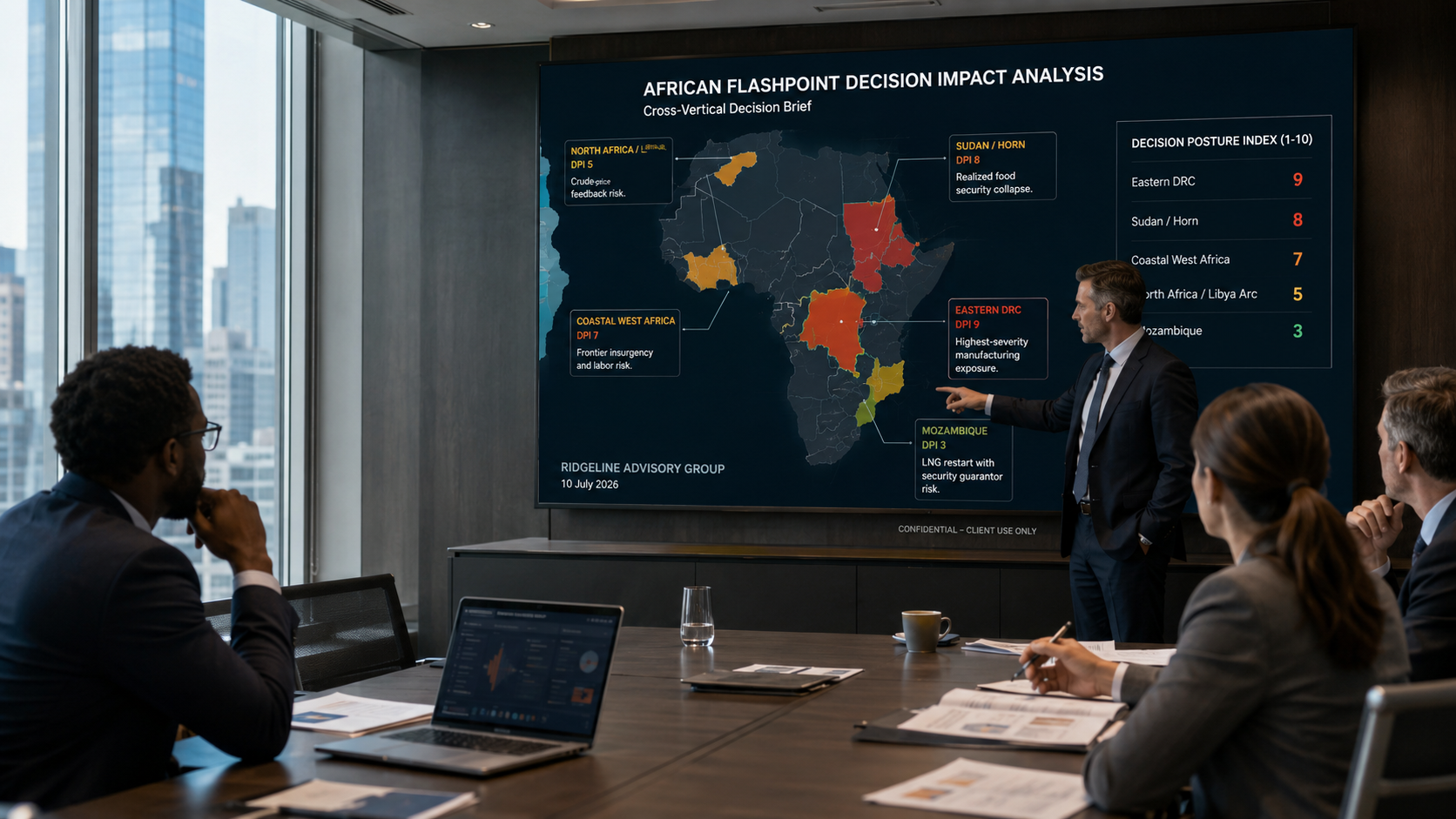
CLIENT INTELLIGENCE ASSESSMENT
African Flashpoint Decision Impact Analysis
A Cross-Vertical Decision Brief for Manufacturing, Agriculture, and Insurance & Financial Services
10 July 2026
Decision Signal System | African Flashpoint Trigger Library Integration
Prepared for: Manufacturing · Agriculture · Insurance & Financial Services Clients
EXECUTIVE SUMMARY
Five African theaters carry active Decision Signal System coverage. Sudan and the Horn. Eastern DRC and the Great Lakes. Coastal West Africa. Mozambique and Cabo Delgado. The North Africa Libya-Algeria arc. None is peripheral to a client with manufacturing, agriculture, or insurance exposure. Each sits on a load-bearing junction of the maritime, mineral, and energy architecture that already governs global supply chains and capital flows. The correct posture is to treat the five as one connected exposure surface, not five country files.
This assessment leads with the decision implications for each client vertical, then provides the supporting regional and cross-theater analysis. Indicator readings are current as of 10 July 2026. Confidence levels are stated explicitly throughout. Where a judgment rests on a fast-moving front or a source base with a known bias, we say so.
Three findings anchor the assessment. First, Eastern DRC is the highest-severity manufacturing exposure in the set, and it runs on two separate mechanisms that require two separate responses. Second, Sudan and the M23 conflict have both crossed their Critical thresholds, which moves them from forward risks to realized conditions that should already be priced. Third, the energy corridor is the connective tissue: it converted a regional set of African risks into a global exposure once already this year, and the pathway for a repeat is open.
The Decision in One Page
Manufacturing. Split Eastern DRC into two tracked exposures. A cobalt price and availability exposure driven by Kinshasa export policy. A separate tin, tantalum, and tungsten exposure driven by armed-group control in the Kivus. A single "DRC risk" line conceals the two responses a manufacturer actually needs.
Agriculture. Treat Sudan as a realized regional food shock now, not a forward risk. Build cocoa and cashew labor contingency around Benin and Togo specifically. Model fertilizer cost against a conditional Gulf energy re-shock, because the corridor already demonstrated the move this year.
Insurance and financial services. Stress-test African political-risk and war-risk books against a single correlated trigger rather than assuming Sudan, DRC, and Mozambique diversify independently. Weight the Mozambique security-guarantor variable as heavily as the local attack tempo, because $20 billion in committed capital now rests on it.
Key Judgments
Judgment 1. High confidence. Eastern DRC is the highest-severity manufacturing exposure, and the driver is policy as much as conflict. The cobalt price shock, up roughly 160% since early 2025, is the product of Kinshasa's export ban and successor quota regime. It is realized, not prospective. Armed-group control of the Kivus is a separate and also severe risk to the tin, tantalum, and tungsten supply chain. Two mechanisms. Two geographies. Two monitoring feeds. They must be tracked apart.
Judgment 2. High confidence. The M23 conflict has crossed the escalation bands that define a regional crisis. M23 holds Goma, Bukavu, and Uvira and runs parallel administrations. UN experts place thousands of Rwandan troops inside the DRC with de facto command. The operative question is no longer whether interstate confrontation occurs. It is whether the Washington and Doha peace tracks now underway can sustain a negotiated de-escalation.
Judgment 3. High confidence. Sudan has crossed its Critical thresholds on conflict intensity and displacement. The mass-atrocity trigger fired when El Fasher fell in October 2025. Displacement falls in the 11-13 million range. The country is functionally partitioned, with the army holding Khartoum and the RSF holding Darfur and much of Kordofan. This is a realized humanitarian and maritime-access crisis, not a forward risk.
Judgment 4. Moderate confidence. Coastal West Africa is not uniform, and treating it as a single bloc conceals the exposure that matters. Benin and Togo carry a permanent frontier insurgency already at or near the theater's Critical event band. Ghana and Côte d'Ivoire remain in an early-warning posture, in which a discontinuous first event poses the risk. A client with concentrated single-country exposure should be scored against that country, not the regional average.
Judgment 5. High confidence. Mozambique LNG has restarted, which concentrates rather than resolves the risk. Force majeure was lifted in November 2025, and full restart followed in January 2026, with first gas expected in 2029. Twenty billion dollars of committed capital now rests on a security arrangement guaranteed by a foreign force. The guarantor's durability is the variable to watch, and it sits largely outside client visibility.
Judgment 6 (dissenting view). Moderate confidence. The North Africa Libya-Algeria arc is scored at the lowest alert level in the set. We assess this as an understatement of its true position. It is the only theater linking directly to two others, Sudan and the Sahel, and it carries the Europe-migration and energy relationship on top. Structural centrality warrants closer client attention than a standalone low rating implies.
The body that follows presents the full decision architecture for each vertical, then provides the regional threat analysis, the cross-theater interconnectedness map, the compound scenario register, and the assumption audit that stress-tests the assessment's foundations.
DECISION ARCHITECTURE BY VERTICAL
This section leads the assessment because it carries the decisions. Exposure is scored across the five theaters on a Decision Posture Index from 1 to 10. The supporting regional analysis follows in the next section for readers who want the underlying reasoning.
Manufacturing
Manufacturing exposure is concentrated in Eastern DRC and operates through two distinct mechanisms. Holding them apart is the single most important decision this vertical faces.
| Theater | DPI (1-10) | Primary Manufacturing Driver |
|---|---|---|
| Eastern DRC (cobalt/policy) | 9 | Realized ~160% cobalt price move from Kinshasa export policy. Availability risk on quota execution and a single congested Katanga corridor. |
| Eastern DRC (3T / conflict) | 8 | Separate tin, tantalum, tungsten traceability and sanctions exposure tied to armed-group control of the Kivus. |
| Coastal West Africa | 5 | Port and corridor logistics risk, concentrated in the Benin and Togo frontier zones, and the Sahel blockade tactic. |
| North Africa / Libya arc | 5 | Crude-price feedback into input costs; Algeria-Mali corridor risk. |
| Sudan / Horn | 4 | Red Sea freight cost pass-through. Limited direct footprint. |
| Mozambique | 3 | LNG-linked energy input, but only from 2029. No 2026 exposure. |
Why must the two mechanisms be tracked apart?
The cobalt exposure is a policy exposure. Cobalt output concentrates in Katanga, hundreds of kilometers from the conflict zone. Its price moved on Kinshasa's decision to ban exports and then meter them through an annual quota, not on any battlefield event. The exposures are price and availability, and the feeds to watch are quota execution and corridor throughput.
Exposure to tin, tantalum, and tungsten is a conflict exposure. Armed groups control the relevant mining and routing in the Kivus, and the risks are traceability and sanctions, with active enforcement already targeting routes to Rwanda. A manufacturer needs a distinct contingency for each. A blended "DRC risk" line will miss one or the other.
The substitution trend is already moving
The cobalt shock is accelerating a structural shift already underway: cobalt-free battery chemistries, Indonesian nickel-cobalt supply, and recycling. A client diversifying now is following that reallocation, not leading it. The strategic question is not whether to reduce DRC cobalt dependency. It is whether to do so as a planned transition or as a forced one.
Decision actions, manufacturing
- Split DRC exposure into two tracked lines: a cobalt price and availability line anchored to quota execution and Katanga logistics, and a 3T traceability and sanctions line anchored to armed-group control of the Kivus.
- Run a 3T supply-chain traceability audit now against active sanctions on conflict-linked routing. Treat any documented linkage as an immediate pause in sourcing.
- Benchmark cobalt exposure against cobalt-free, Indonesian, and recycled-content substitution economics, so any pivot is planned rather than reactive.
- For Gulf of Guinea logistics, pre-negotiate alternative routing weighted to Benin and Togo frontier risk specifically, not to a blended regional score.
Agriculture
Agricultural exposure runs through three channels: direct food security in and around Sudan; corridor and labor risks for cocoa and cashew in Coastal West Africa; and fertilizer input costs transmitted through the energy corridor.
| Theater | DPI (1-10) | Primary Agriculture Driver |
|---|---|---|
| Sudan / Horn | 9 | Realized food-security collapse. FEWS NET deterioration and regional grain and livestock spillover. |
| Coastal West Africa | 7 | Cocoa and cashew corridor labor risk is concentrated in Benin and Togo. Sahel blockade tactic now live. |
| North Africa / Libya arc | 6 | Fertilizer input-cost pass-through via energy corridor; EU guest-worker and Mediterranean labor pressure. |
| Eastern DRC | 3 | Limited direct relevance beyond regional displacement pressure on host-state food systems. |
| Mozambique | 3 | Displacement pressure on host-district food systems. |
Sudan is a realized regional food event
Sudan's food-security deterioration is regional, not national. FEWS NET signals a compound with displacement into Chad, Egypt, and South Sudan, straining grain and livestock markets across the Horn and raising humanitarian procurement costs for any commodity or agribusiness client with regional exposure. This is a present cost-to-price, not a scenario to monitor.
Labor precedes closure in the coastal corridor
In Benin and Togo, the variable to watch is labor availability, not attack counts. Cocoa and cashew harvests in northern border districts depend on seasonal labor mobility that a security cordon disrupts before any formal corridor closure. Given West Africa's concentrated share of the world cocoa supply, labor disruptions are transmitted to global cocoa prices.
Fertilizer is the cross-vertical thread
Nitrogen fertilizer production is gas-intensive. Gas pricing is exposed to the same Gulf energy corridor that spiked this year. A sustained fertilizer price move feeds into global food indices with a multi-month lag, landing hardest on the same food-insecure populations already stressed by the situation in Sudan. African food insecurity, energy-corridor disruption, and global fertilizer pricing are one story with three entry points.
Decision actions, agriculture
- Treat Sudan as a realized regional grain and livestock shock now. Reassess procurement cost assumptions rather than waiting for a further trigger.
- Build cocoa and cashew labor-availability contingency tied to Benin and Togo counterinsurgency posture specifically, since labor disruption precedes corridor closure.
- Model fertilizer input costs against a conditional Gulf energy re-shock, given the corridor has already demonstrated the move this year.
- Monitor North Africa migration transit as a leading indicator of EU seasonal agricultural labor availability.
Insurance and Financial Services
This vertical offers the broadest exposure because every regional dynamic in this assessment ultimately surfaces as a pricing, capacity, or sovereign credit question. The distinguishing risk is correlation.
| Theater | DPI (1-10) | Primary Insurance / FinServ Driver |
|---|---|---|
| Sudan / Horn | 8 | Marine war-risk premiums, humanitarian operator liability, sanctions, and counterparty exposure. |
| Mozambique | 8 | $20B in project finance and political risk insurance concentrated on one asset, backed by a foreign security guarantor. |
| Eastern DRC | 7 | Political risk insurance for mining and infrastructure, ESG liability, and sanctioned-supply-chain exposure across two mechanisms. |
| Coastal West Africa | 6 | Port and cargo war-risk, political risk insurance for agribusiness and logistics, concentrated in Benin and Togo. |
| North Africa / Libya arc | 6 | Sovereign and trade credit tied to Libyan oil export stability; migration-linked EU policy risk. |
The correlation risk is the sharpest exposure
Sudan, DRC, and Mozambique political-risk and war-risk exposure can deteriorate together under one shared trigger: a Gulf energy re-shock combined with reduced Western crisis-response bandwidth. That looks like diversified African exposure right up until the correlated trigger arrives. Repeated correlated losses would then accelerate the withdrawal of reinsurance capacity from African political-risk lines generally, raising the cost of coverage even for clients and theaters that did not contribute to the loss event.
Mozambique is the cleanest single-asset test
Mozambique LNG is the clearest case in the set of how political risk insurance markets price a foreign-guarantor dependency. Public export-credit agencies have already reassessed support, which is a leading signal for private capacity. If the security guarantor's position weakens, underwriters will be pricing the durability of a bilateral political arrangement that sits outside most underwriters' direct visibility.
Decision actions, insurance, and financial services
- Stress-test African political-risk and war-risk books against a single correlated trigger rather than assuming independent diversification across Sudan, DRC, and Mozambique.
- For Mozambique LNG exposure, weight the security-guarantor stability variable at least as heavily as the local attack tempo, and treat export-credit-agency posture as a leading capacity signal.
- Build sanctions and counterparty due diligence around Sudan sponsor-intervention escalation, given active arms-embargo exposure across regional routes.
- Monitor reinsurance capacity for African political-risk lines as a portfolio-level early warning, independent of any single-country deterioration.
REGIONAL THREAT ARCHITECTURE
This section provides the supporting analysis behind the decisions above. Each theater is divided into three tiers. First-order effects are direct and immediate. Second-order effects surface within one to two quarters. Third-order effects are structural and hard to reverse. Each region closes with its cross-theater linkage.
Eastern DRC and the Great Lakes
The discipline in this theater is to keep two mechanisms apart: the armed-group conflict over the tin, tantalum, and tungsten economy and the cobalt price shock driven by Kinshasa's export policy.
The conflict and the 3T supply chain
M23, within the Alliance Fleuve Congo, holds Goma, Bukavu, and Uvira and runs parallel administrations. UN experts place thousands of Rwandan troops inside the DRC with de facto control. What the group controls economically is the tin, tantalum, tungsten, and gold economy. The coltan hub at Rubaya, producing an estimated 15 to 20% of global supply, has been under its control since April 2024. This is a 3T exposure, not a cobalt exposure.
The cobalt price shock and Kinshasa policy
Cobalt output concentrates in Katanga, around Kolwezi, hundreds of kilometers from the conflict. The shock there is a policy event. Kinshasa imposed a full export ban in early 2025, then replaced it with an annual quota of roughly half of prior-year volumes. Cobalt metal moved from about $21,500 per tonne to $56,000 to $62,000 within roughly a year, with producers physically moving a fraction of allocations through one congested corridor. The exposure is realized, and the feed to watch is quota execution and logistics throughput.
| Indicator | Assessed Tier | Rationale |
|---|---|---|
| Armed-group territorial control (3T / Kivus) | ELEVATED to CRITICAL | Three provincial-tier cities held parallel administrations. At or near the top band. |
| Cobalt disruption index (Katanga / policy) | ELEVATED | Realized ~160% price move on export ban and quota. Shipment far below allocation. Separate from the conflict score. |
| MONUSCO withdrawal stage | ELEVATED | Drawdown proceeding against rising, not falling, contestation. |
| Rwanda-DRC escalation | ELEVATED | RDF presence documented. Near-confrontation already occurred; now in mediation. |
| Critical mineral ESG compliance (3T) | ELEVATED | Active sanctions on conflict-linked mineral routing. Traceability exposure live for 3T. |
The peace track
A negotiated track runs in parallel to the fighting. A US-brokered process produced a Declaration of Principles in mid-2025. A framework agreement followed later that year, and terms for a ceasefire monitoring mechanism were signed in early 2026. Fighting continues alongside these talks, but their existence shapes the outlook: the interstate near-confrontation is not a distant tail risk. It has occurred and is now the subject of active mediation, with the durability of the mediation being the central uncertainty.
Effects chain
First-order. Conflict-linked 3T routing to Rwanda draws sanctions. Cobalt allocations sit unshipped against congested logistics. Peacekeeping thins as contestation rises.
Second-order. Manufacturers face two distinct exposures requiring two contingency plans. Neighboring states absorb rising displacement pressure.
Third-order. The cobalt shock accelerates substitution that will not reverse even if DRC conditions later stabilize. On 3T, a failure of the peace track would harden armed groups' control over coltan into a durable feature of the tantalum market.
Cross-theater linkage
The library scores a MODERATE DRC-to-Venezuela linkage as a resource-nationalism parallel. It is analogical, not operational. The cobalt story is the clearest expression of that archetype, a state export-policy event, but a DRC event does not transmit into Venezuelan markets. The two rhyme. They do not move each other.
Sudan and the Horn of Africa
Sudan is a realized humanitarian and maritime-access crisis sitting directly on top of an already-stressed global chokepoint.
| Indicator | Assessed Tier | Rationale |
|---|---|---|
| SAF-RSF conflict intensity | CRITICAL | El Fasher fell in October 2025, with roughly 2,000 killed in one week. Drones now drive the majority of civilian deaths. |
| Humanitarian access | ELEVATED to CRITICAL | El Fasher was sealed for 18 months and later described by the UN as a crime scene. Access obstructed by both parties. |
| Neighbor and sponsor intervention | ELEVATED | Credible external material support to the RSF, with arms-embargo exposure across regional routes. |
| Displacement milestone | CRITICAL | Roughly 11 to 13 million displaced against a 10 million threshold. Around 1.2 million have returned to Khartoum. |
| Horn maritime access linkage | ELEVATED | Port Sudan and southern Red Sea access degraded. Shared flag with the Red Sea dashboard. |
A partitioned country
The map has shifted decisively. The army has retaken Khartoum, and the government has returned to the capital. The RSF has consolidated Darfur, holding all five regional capitals and much of Kordofan, and has declared a parallel government. The country is functionally partitioned. The next pressure point is Kordofan, with warnings of mass-atrocity risk around El Obeid.
Effects chain
First-order. Partition hardens. Displacement pressure lands on Chad, Egypt, and South Sudan. Drone warfare sustains the civilian casualty tempo.
Second-order. Host-state labor markets absorb displaced workers. Regional grain and livestock markets tighten. Sanctions and counterparty exposure rises for any entity touching sponsor networks. Port Sudan war-risk premiums move with the maritime flag.
Third-order. A durable partition would reset sovereign risk, concession stability, and cross-border security for a generation. A Port Sudan corridor failure would trigger structural rerouting that persists past the immediate crisis because switching costs and new insurer relationships do not revert quickly.
Cross-theater linkage
The Sudan-to-Red Sea linkage is STRONG and operational. Port Sudan flow, corridor status, and war-risk premiums are a shared dependency with the Red Sea dashboard. Secondary MODERATE linkages extend into the Mali-Sahel and the Libya arc via the Libya-Chad-Sudan corridor.
Coastal West Africa
This theater is not uniform. The exposure that matters is concentrated in Benin and Togo, and a blended regional score conceals it.
| Country / Indicator | Assessed Tier | Rationale |
|---|---|---|
| Benin frontier activity | ELEVATED to CRITICAL | Northern Benin attacks and fatalities escalated sharply through 2024 and 2025. 2025 fatalities exceeded all prior years combined. At or above the theater band in one country. |
| Togo frontier activity | ELEVATED | Sustained Savanes-region attacks. A permanent frontier presence, not isolated events. |
| Ghana / Côte d’Ivoire | WATCH to ELEVATED | Discontinuity risk applies here. Spillover is present; first major events are not yet realized. |
| ECOWAS coherence | ELEVATED | AES exits and parallel bloc formation. Border and customs friction visible. |
| Côte d’Ivoire port logistics | WATCH to ELEVATED | Corridor security incidents are rising. Not yet gateway disruption. |
The Sahel blockade tactic
A supply-strangulation tactic is already live in the Sahel. Insurgent forces have blockaded Malian supply lines since September 2025, destroying over 300 fuel tankers and stranding more than 2,000 containers at the Port of Dakar by late November, with estimated monthly losses to Senegal near $26.5 million. The coastal corridors, Abidjan, Tema, Lome, and Cotonou, are the next exposure surface for the same tactic.
Effects chain
First-order. Benin and Togo absorb sustained frontier attacks. The Mali corridor blockade raises landed costs across the Sahel. ECOWAS-AES fragmentation continues.
Second-order. Port and corridor risk reprices at the Gulf of Guinea gateways. Cocoa and cashew corridor labor faces disruption. Customs friction complicates regional-integration assumptions.
Third-order. Insurgency risks normalizing as a permanent feature of littoral political economy rather than a temporary overflow, durably raising the political-risk base rate for the coastal bloc.
Cross-theater linkage
The Coastal-to-Mali-Sahel linkage is STRONG and operational. It is the direct spillover zone. Coastal counts are kept geographically bounded so that they complement, rather than duplicate, the Mali-Sahel set.
Mozambique and Cabo Delgado
The project has restarted, which concentrates the risk rather than resolving it.
| Indicator | Assessed Tier | Rationale |
|---|---|---|
| Cabo Delgado ISM attack count | WATCH to ELEVATED | Renewed activity near the N380 and the Afungi approach. Below a coordinated district-level campaign. |
| LNG project continuity | ACTIVE, elevated watch | Force majeure lifted November 2025. Full restart January 2026. Project at 40%. First LNG expected in 2029. |
| Security guarantor stability | WATCH to ELEVATED | The backstop the restart depends on. Renewal friction is now a higher-stakes variable given $20B of committed capital. |
| Cabo Delgado displacement | ELEVATED | Cumulative displacement near the 1.0 to 1.3 million band, with re-displacement risk in LNG-adjacent districts. |
The dependency the restart created
The restart concentrates twenty billion dollars of committed capital behind a security arrangement guaranteed by a foreign force. First gas is not expected until 2029, so the project's near-term value to the global gas market is nil. Its significance to a client is entirely a project-finance and political-risk question, and that question turns on the durability of the guarantor arrangement.
A signal for the insurance vertical
Public export-credit agencies have reassessed their support for the project, tied to unresolved security and community concerns. Public-underwriter caution is a leading indicator for private political-risk capacity. Underwriters pricing this asset are effectively pricing the durability of a bilateral security arrangement that sits outside their direct visibility.
Effects chain
First-order. Construction ramps under a containment-security perimeter. Attack tempo pressures the approach corridor. The guarantor force holds the line.
Second-order. Project finance and political risk insurance price the guarantor dependency directly. Any renewal friction increases the probability of an attack tempo around the deployment zone.
Third-order. A guarantor drawdown before first gas would strand committed capital and remove a future non-Gulf supply option that buyers are counting on for the 2030s.
Cross-theater linkage
The linkage to the Gulf energy corridor is MODERATE and is driven by future substitution economics, not by present coupling. It matters for the 2029-plus horizon. It does not transmit into the 2026 market.
North Africa and the Libya-Algeria Arc
Scored at the lowest alert level in the set. We register a dissent, developed in the assumption audit.
| Indicator | Assessed Tier | Rationale |
|---|---|---|
| Libya governance faction control | WATCH | Dual-authority stalemate persists without national-scale escalation. Oil-facility coercion is a standing wildcard. |
| Algeria’s regional security posture | WATCH | Reinforced border posture around the Libya and Sahel arcs. One step above routine. |
| North Africa migration transit pressure | WATCH to ELEVATED | Rising flows and route shifts, with periodic spikes in interception and return. |
Effects chain
First-order. Libya's stalemate holds. Algeria maintains a reinforced but non-escalatory posture. Migration flows rise and fall with shifts in routes.
Second-order. Oil-facility coercion is a live wildcard for national oil export controls, with outsized market-signaling weight given Libya's role as a swing producer. Algeria's posture shapes the Mali-Sahel-Sudan corridor environment. EU migration policy is under pressure, affecting European agricultural labor availability.
Third-order. A renewed Libyan civil war would remove a swing producer while Gulf supply is already contested. An Algeria-Mali rupture would strip the Sahel of a rare mediator at its point of maximum strain. An EU-North Africa migration rupture would reshape European labor and asylum politics for years.
Cross-theater linkage
North Africa exhibits MODERATE linkages to both the Mali-Sahel and Sudan. No other theater links directly into two others. That centrality is the basis of the dissent on its rating.
CROSS-THEATER INTERCONNECTEDNESS
Three structural patterns govern how the African theaters connect to one another and to the wider Decision Signal System.
Two operational couplings, the rest analogical or substitution-based
Only two linkages touching Africa are strong and operational. Sudan to the Red Sea. Coastal West Africa to Mali-Sahel. The others are moderate but run through different mechanisms. The DRC-Venezuela linkage is analogous to resource nationalism. The Mozambique linkage is future substitution economics. The North Africa linkage is shared corridor geography. Treating all three as a single category obscures the fact that they behave differently under stress. A client should weight the operational couplings for days-to-weeks transmission and the others for slower, structural effects.
Africa reads as decoupled from the Indo-Pacific and Europe
The African theaters show little scored linkage to Taiwan, the South China Sea, Korea, the Baltics, the Black Sea, or India-Pakistan. This should be read with caution. An absent score may reflect a genuine absence, or it may reflect a framework built around Euro-Atlantic strategic attention that has not yet been asked to address a shared variable, such as Chinese capital allocation spanning DRC minerals and Indo-Pacific supply chains at the same time.
Energy is the connective tissue
Every African theater that links outward does so through energy. Sudan through the Red Sea corridor. Mozambique through future LNG substitution. Libya through its swing-producer role. The single leading indicator for whether an African flashpoint acquires global rather than regional significance is sustained crude pricing combined with any African energy corridor or production disruption. That combination converted this set from regional to global once already this year.
The energy re-trigger
The energy conversion trigger is conditional and live. A sustained move in crude toward the $100 to $120 range, combined with any disruption to African energy corridors, is the pathway that turns a regional African story into a global cross-vertical one. Clients across all three verticals should treat this as a standing watch item because it moves faster than any single country indicator and strains capacity across theaters simultaneously.
COMPOUND SCENARIO REGISTER
Three cascade scenarios frame the compound risks that cut across theaters. Each carries a trigger set, a cascade chain, affected systems, a time horizon, a probability band, and the early-warning indicators to monitor.
Scenario A: Red Sea-Horn Compound Closure
| Field | Assessment |
|---|---|
| Trigger flashpoints | Sudan / Horn plus Red Sea / Bab el-Mandeb |
| Cascade chain | The Sudan conflict, already in the Critical band, drives a further surge in displacement and a failure of the Port Sudan corridor. This coincides with renewed disruption in the Bab el-Mandeb and Hormuz approaches. The two corridors force rerouting of aid, imports, and cargo around the southern Red Sea. |
| Affected systems | Marine war-risk, humanitarian logistics, Horn food security, sanctions and counterparty compliance, Red Sea shipping insurance |
| Time horizon | Three to twelve months |
| Probability (12-month) | Moderate to high. Both legs have fired independently within the past year. Joint recurrence requires correlation, not novel low-probability events. |
| Early warning indicators | Sudan conflict intensity sustained in the Critical band; Horn maritime flag at level 2 or 3; renewed Gulf chokepoint disruption |
Scenario B: Great Lakes Peace Failure and 3T Shock
| Field | Assessment |
|---|---|
| Trigger flashpoints | Eastern DRC / Great Lakes |
| Cascade chain | The Washington and Doha peace tracks collapse. Armed groups further consolidate control in the Kivus and harden their control over the coltan economy. A sanctioned supply chain event occurs for at least one major routing network. This is a tin, tantalum, and tungsten scenario. Cobalt risk runs on the separate Kinshasa-policy track. |
| Affected systems | Global 3T and tantalum supply, electronics and defense manufacturing, humanitarian systems across the Great Lakes, DRC sovereign and concession risk |
| Time horizon | Six to eighteen months |
| Probability (12-month) | Moderate. The near-confrontation has already occurred. The live question is whether active mediation holds. |
| Early warning indicators | Collapse of the monitoring mechanism terms; RDF redeployment; expansion of sanctions on conflict-linked 3T routing |
Scenario C: Sahel-Coastal-Libya Arc Failure
| Field | Assessment |
|---|---|
| Trigger flashpoints | Mali / Central Sahel plus Coastal West Africa plus North Africa / Libya arc |
| Cascade chain | The Mali blockade, already in effect, extends its tactics to the coastal corridors. Benin and Togo frontier activity, already elevated, is further elevated. Algeria’s border posture escalates, straining its mediating role. Libya-Chad-Sahel arms and fighter flows intensify. |
| Affected systems | Gulf of Guinea ports and corridors, West African agribusiness, ECOWAS and AES architecture, Algerian and Libyan posture, Mediterranean migration |
| Time horizon | Twelve to thirty-six months |
| Probability (12-month) | Moderate on the partial Mali-plus-coastal version, which is partially underway. Lower on the full three-theater simultaneous version. |
| Early warning indicators | Benin and Togo frontier counts sustained in the elevated band; Algeria posture at level 2 or 3; ECOWAS coherence below 25; blockade tactic appearing on coastal corridors |
Economic-impact figures are deliberately omitted. A standardized African cascade-impact methodology is still in development, and placeholder ranges would imply a precision the data does not yet support.
ASSUMPTION AUDIT
Ridgeline holds its own assessments to the same scrutiny it applies to any client's reasoning. This section stress-tests the load-bearing assumptions behind the analysis so clients can weigh them directly.
Threshold calibration
The alert thresholds are decision-intelligence defaults. A global trigger of forty events per quarter does not carry the same meaning in a state with strong institutions as in one without them. Benin already sits at that band. Ghana does not. A client with concentrated single-country exposure should have the thresholds recalibrated against that country's baseline rather than accepting the regional default.
Source base
The source base supports directional judgments more reliably than precise ones. Event-coded conflict data undercounts violence where media access is worst, which is often where violence is worst. Peacekeeping reporting carries a mandate incentive. Operator self-reporting on a project's own security carries a direct conflict of interest, which is why clients with material Mozambique exposure should seek independent corroboration of operator security statements.
Escalation is not always linear
Sudan and DRC both demonstrate discontinuous escalation. El Fasher fell in a single week. Goma fell in days. A four-tier ladder implies a client will observe each stage with time to react. These conflicts do not always move that way. Treat the ladder as a monitoring structure, not a promise of proportional warning time.
The theaters are not cleanly separable
Sudan-Libya-Chad flows, Sahel-to-coastal spillover, and the Libya-Algeria-Mali corridor cut across the boundaries the framework draws for organizational purposes. An event filed under one theater may be best explained by a dynamic in another. Analysts and clients should keep reading across regional lines.
Source framing and regional actors
The source set is substantially Euro-Atlantic in character. It may underweight the actors most directly shaping outcomes on the ground: Gulf involvement in Sudan, Russian security-contractor posture in the Sahel, and Chinese capital across DRC mineral concessions. Chinese firms control most of the DRC's foreign-owned cobalt capacity, which is directly relevant to the cobalt mechanism at the center of the manufacturing assessment. Ridgeline actively sources Gulf, Chinese, and regional African perspectives as a standing corrective.
Structural blind spots worth naming
- A chokepoint-and-state-conflict framework may under-capture African risk, where informal governance and sub-national variation often matter more than national indicator scores.
- Indicator coverage is thin in places. Three indicators for the entire North Africa theater can create false precision, a single rating standing in for a complex situation.
- There is no Nigeria-specific indicator. Nigeria is central to West African security, ECOWAS coherence, and Gulf of Guinea economic weight, and this gap warrants direct client attention.
- The coastal bloc should always be read disaggregated by country. A single regional score conceals the divergence between Benin-level and Ghana-level exposure.
Confidence Statement
Confidence is highest on the cobalt-policy mechanism and the Sudan and DRC threshold crossings. These are well-documented across independent sources and are realized conditions, not forecasts. Confidence is lower on precise interconnectedness scoring, cascade probabilities, and the coastal first-event timing for Ghana and Cote d'Ivoire, which rest on thinner base rates. Clients should weight the high-confidence judgments accordingly and treat the lower-confidence ones as monitoring priorities rather than settled conclusions.
MONITORING AND WATCHLIST
A client with concentrated exposure should tighten monitoring cadence on the indicators that matter to their book. Recommended priorities by vertical follow.
| Vertical | Priority Indicators | Baseline Cadence | Recommended Client Cadence |
|---|---|---|---|
| Manufacturing | Cobalt disruption index (quota execution, Katanga corridor) | Monthly | Weekly. A policy feed, not a conflict feed. Watch quota deadlines and shipment gaps. |
| Manufacturing | 3T territorial control and ESG (Kivus, coltan, sanctions) | Monthly | Weekly for direct 3T sourcing exposure. Separate feed from cobalt. |
| Agriculture | Sudan humanitarian access and displacement | Bi-weekly | Weekly. Already past Critical. Track Kordofan and El Obeid. |
| Agriculture | Benin and Togo frontier counts; coastal counterinsurgency posture | Monthly | Bi-weekly, disaggregated by country. |
| Insurance / FinServ | Horn maritime flag; Sudan sponsor-intervention flag | Weekly | Daily during any surge period. |
| Insurance / FinServ | Mozambique continuity; security-guarantor stability; export-credit posture | Event-driven | Bi-weekly given single-asset concentration and $20B at stake. |
| All | Gulf chokepoint status and crude level as the energy re-trigger | Event-driven | Daily during any Gulf escalation. |
Two standing watch items apply across all three verticals regardless of concentration: the Sudan-Red Sea linked flag and the energy re-trigger, given the demonstrated tendency of both to convert a regional African story into a global cross-vertical one with limited additional warning.
COVERAGE GAPS AND FORWARD DISCIPLINE
Ridgeline names its coverage gaps directly rather than leaving them as silent assumptions. There is no Nigeria-specific indicator, the most significant structural gap in the current set. There is no standardized African cascade-impact methodology, so this assessment omits dollar figures rather than inventing them. The coastal first-event timing for Ghana and Cote d'Ivoire rests on a thin base rate and should not be read as a reliable predictor of warning time.
This assessment establishes a baseline dated 10 July 2026. Ridgeline recommends a structured review of these judgments against realized outcomes at the six-month and twelve-month marks, consistent with the prediction-audit discipline applied across its published work.
APPENDIX: INDICATOR REFERENCE TABLE
All 21 indicators with current status readings as of 10 July 2026.
| Indicator | Region | Status | Note |
|---|---|---|---|
| SAF-RSF conflict intensity | Sudan / Horn | CRITICAL | El Fasher, ~2,000 killed in a week |
| Sudan humanitarian access | Sudan / Horn | ELEVATED-CRITICAL | 18-month El Fasher siege; obstruction by both parties |
| Sudan sponsors intervention | Sudan / Horn | ELEVATED | Arms-embargo exposure across regional routes |
| Sudan displacement | Sudan / Horn | CRITICAL | ~11 to 13M vs 10M threshold |
| Horn maritime access | Sudan / Horn | ELEVATED | Shared flag with Red Sea dashboard |
| DRC armed-group control (3T) | DRC | ELEVATED-CRITICAL | Goma, Bukavu, and Uvira held parallel administrations |
| Cobalt disruption index (policy) | DRC | ELEVATED | ~160% price move on export ban and quota; tracked separately |
| MONUSCO withdrawal | DRC | ELEVATED | Drawdown against rising contestation |
| Rwanda-DRC escalation | DRC | ELEVATED | RDF presence documented; now in mediation |
| Critical mineral ESG (3T) | DRC | ELEVATED | Active sanctions on conflict-linked routing |
| Coastal WA frontier (Benin) | Coastal WA | ELEVATED-CRITICAL | 2025 fatalities exceed all prior years |
| Coastal WA frontier (Togo) | Coastal WA | ELEVATED | Permanent frontier presence |
| Coastal WA (Ghana / CIV) | Coastal WA | WATCH-ELEVATED | Discontinuity risk applies here |
| ECOWAS coherence | Coastal WA | ELEVATED | AES exits; border and customs friction |
| Côte d’Ivoire port logistics | Coastal WA | WATCH-ELEVATED | Corridor-security incidents rising |
| Cabo Delgado ISM count | Mozambique | WATCH-ELEVATED | Activity near N380 and Afungi approach |
| LNG project continuity | Mozambique | ACTIVE | Restart Jan 2026; first LNG 2029 |
| Security guarantor stability | Mozambique | WATCH-ELEVATED | Backstop for $20B of committed capital |
| Cabo Delgado displacement | Mozambique | ELEVATED | Near 1.0 to 1.3M band |
| Libya faction control | North Africa | WATCH | Dual-authority stalemate; oil-facility wildcard |
| Algeria’s security posture | North Africa | WATCH | Reinforced border posture |
| NA migration transit | North Africa | WATCH-ELEVATED | Rising flows; EU policy pressure |